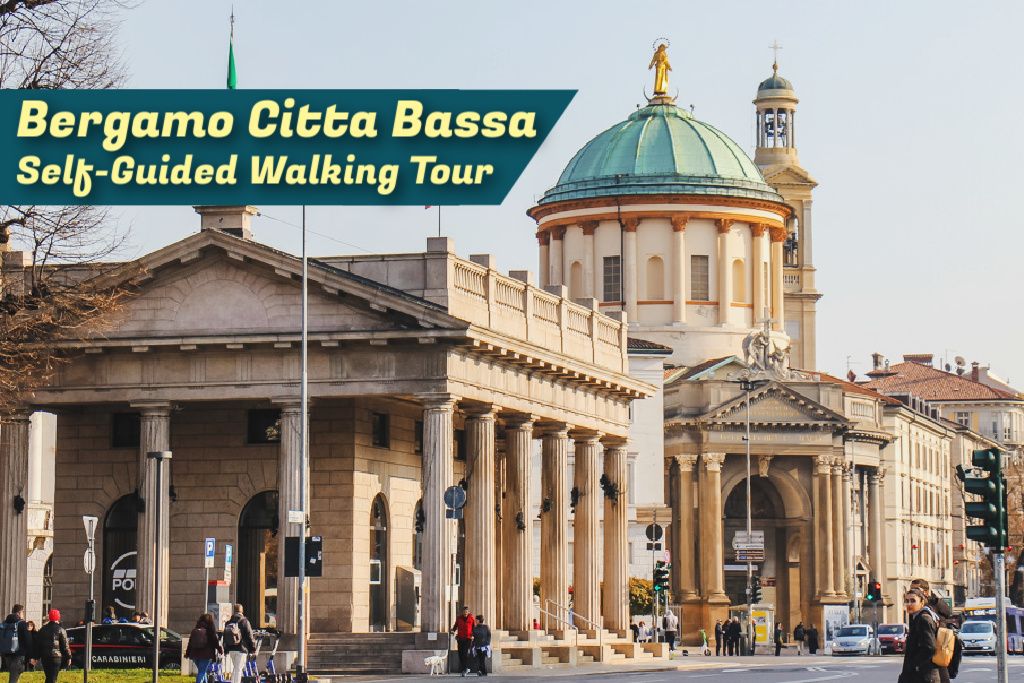
Bergamo, Italy is a dualistic municipality with two contrasting centers: Citta Alta (the Upper City) and Citta Bassa (the Lower City).
While Citta Alta welcomes visitors with its medieval charm, Citta Bassa is more subtle. Although often overlooked, we believe the Lower City is enchanting in a completely different way from its more popular counterpart.
Our site utilizes Affiliate Links. If you use them to make a purchase, we may earn a commission. For more information, read our Disclosure Policy.
Boasting wide shopping lanes, elegant architecture, hidden gardens and countless churches, the Lower Town is quintessentially Italian.
During our month-long stay in Bergamo, we routed our way to many intriguing attractions and sublime sights.
Based on our personal experiences, we created this Self-Guided Bergamo Citta Bassa Walking Tour to showcase the absolute best of the Lower City!
About Our Bergamo Citta Bassa Walking Tour
Our outlined walk in Bergamo’s Lower City is about 2 miles long and will take roughly 2 hours to complete. For each stop on our Citta Bassa tour, we have provided a map link for walking directions.
We begin the tour at Porta Nuova, which is just a short walk from the train station – and end in the delightful Borgo Santa Caterina neighborhood on the east side of town.
In fact, the last stop is just a stone’s throw from the beginning of our Bergamo Citta Alta Walking Tour. Pairing the two together is a fabulous way to get to know both sides of the city!
What You Will Need for Your Tour of Bergamo
For this pleasant (and mostly flat) walk through Citta Bassa, you will still want a few essentials.
Durable Shoes: When exploring any city in Europe, it’s best to wear comfortable travel shoes.
Travel Camera: Bergamo is beautiful, be ready to capture it! We use a Canon Rebel with a 18/135mm lens.
Day Bag: Keep your hands free by wearing a zippered day pack (that also deters pickpockets).
Portable Charger: Don’t forget a power bank for a mid-walk boost!
Wireless Connection: For directions, you will need connectivity. If traveling from abroad, upgrade to an international plan, get an eSim or buy a Pocket WiFi device (we like GlocalMe).
Self-Guided Walking Tour: Citta Bassa Bergamo

Okay, now that we’ve got that out of the way, there is a lot to see in Bergamo, so let’s get started!
#1 Porta Nuova

MAP. Begin your Citta Bassa Self-Guided Walking Tour at Porta Nuova, the grandiose gate to the Lower City Center.
No longer a gate in the true sense of the word, the emblematic doorway frames the main thoroughfare, Viale Papa Giovanni XXIII Street, with a picture-perfect view of the Upper Town in the distance.

The two opposing Neoclassical propylaea were built in 1837 to accommodate customs offices and are characterized by striking columns.
Before passing through the gates, consider stepping inside Chiesa Santa Maria Immacolata delle Grazie (MAP). The domed church features impressive frescoes and a small museum.
#2 Torre dei Caduti

MAP. The next sight on your Lower City Walking Tour is the remarkable Torre dei Caduti – or the Tower of the Fallen – in Piazza Vittorio Veneto.
Dedicated to the soldiers lost during World War I, the nearly 150-foot-tall memorial stands as a symbol of Bergamo.
Inside, there is a small museum – and the open-air deck at the top of the tower offers an exceptional panorama. A ticket is required to enter.
Fun Fact: Also standing on the square is an obelisk dedicated to Napoleon Bonaparte. He is honored for his positive impact on the city during his rule in the early 19th century.
#3 Piazza Matteotti

MAP. The spacious square that extends to the west is Piazza Matteotti. Serving as the center of Bergamo’s administration, it’s bounded by government buildings and dotted with important monuments.
Monumento al Partigiano (MAP) depicts a woman peering at a man who is hanging by his feet. It is dedicated to victims of the Italian Resistance Movement who fought against fascism during WWII.
Standing in front of the Municipality of Bergamo is a statue of Vittorio Emanuele II (MAP). Reigning as the first king of Italy (crowned in 1861), he is credited with unifying the country.
The pale-yellow building with Corinthian pilasters and arched windows to the north is Palazzo Frizzoni (MAP). Built in the 1830s as a residence, it was donated to the city in 1927. Today it still houses the Mayor’s Office and City Council.
DETOUR: Bergamo Gelato

If you think this tour would be better with gelato in hand (as most Bergamo walks are), you are in luck. Two of the best gelato shops in Bergamo – Gelateria la Romana and Carmen – are around the corner!
Pause your Citta Bassa self-guided tour and grab a cone or cup. Then, retrace your steps and enjoy your treat as we stroll up one of the Lower City’s prettiest streets.
#4 Via XX Settembre, Bergamo

MAP. A wide pedestrianized lane that snakes through the city’s shopping district, Via XX Settembre is a must-see in Citta Bassa.
It marks the beating heart of Bergamo’s ‘Fashion Quadrilateral’ – a four-street commercial hub.
The buzzing space is lined with a blend of 19th century Victorian architecture and older Renaissance and Baroque designs.
Most of the buildings are occupied by modern brand-name retailers, but there are a few historic gems along the way.

The Church of the Blessed Virgin of Spasimo (MAP) is a small house of worship that is easy to miss but well worth popping inside to see the gilded interior.
The church is dedicated to St. Lucia. According to local tradition, she and her donkey deliver presents on the night of December 12 (so it’s a madhouse of children dropping off letters at Christmastime).
Chiesa di San Leonardo (MAP) is another church nearly hidden in plain sight. While not particularly exceptional, it can trace its roots to the 11th century – we like it for its simple quaintness.
Via XX Settembre ends at Largo Nicolo Rezzara, which is marked by a fountain and lovely arcaded buildings.
#5 Basilica di Sant’Alessandro in Colonna

MAP. Continue your Lower Town Bergamo Walking Tour by strolling up Via Sant’Alessandro. It’s an idyllic and atmospheric street, where restaurants and bars spill onto the sidewalks.
The lane leads to the Basilica of St. Alexander in Column, one of the most important churches in Citta Bassa.
Named in honor of the city’s patron saint, the church is classically decorated with fine embellishments and precious paintings.

The most revered is “Lamentation over the Dead Christ’ by famed Renaissance artist, Lorenzo Lotto (you can find it in the third side chapel on the right).
Lotto thrived during his 10-plus years in Bergamo, creating bright and bold altarpieces (many of which you will see on this walk in Citta Bassa).
While the interior is exceptional, it’s the pillar that stands in front of the church that is most intriguing.
Comprised of pieces of a former 4th century cathedral dedicated to St. Alexander, the column is said to mark where the saint was beheaded in 303 AD.
#6 Via Sant’Orsola

MAP. Complete your loop through the Fashion District by retracing your steps to Via Sant’Orsola. The narrow pedestrian lane boasts boutique shops stocked with goods made by local designers.
Take a peek inside Piccole Gioie Di Poluektova Marina Accessori Moda (MAP); it’s a classy spot that sells beautiful hats.
Step through the arcades to Casa Della Penna (MAP); this store is dedicated to writing accessories. If you are into high-end, second-hand clothing, be sure to check out Glamour e Vintage (MAP).
#7 Chiostro di Santa Marta

MAP. Obscured within the Galleria Crispi Shopping Arcade, the Cloister of St. Marta is an oasis in the center of the bustling metropolis.
The cloisters are all that remain of a 14th century monastery – and they have been pristinely preserved.
We could only peer through the locked gate, but still got a good glimpse of the courtyard, covered walkways and sculptures.
#8 Piacentiniano Center

MAP. A contemporary redevelopment project in the early 20th century, Piacentini Center is the conglomeration of structures set in the heart of the Lower City.
Overtaking the ancient St. Alexander’s Fair, it was designed by famous Italian architect Marcello Piacentini to house financial institutions, admin offices and commercial retailers.
The stately buildings – which include the Bank of Italy, the Palace of Justice, the Chamber of Commerce and the Donizetti Theater – feature a harmonious design.
The stylish Quadriportico del Sentierone, however, is the standout of the urban renewal project. It boasts graceful arches and is occupied by shops and cafes. It’s a popular meeting spot for locals and visitors, alike.
#9 Piazza Dante and Fontana del Tritone

MAP. By the 18th century, St. Alexander’s Fair had grown to be a busy marketplace of more than 500 shops…and where Piazza Dante is today was the center of it.
During the Piacentini project, the shops were demolished, leaving room for the majestic Dante Square to take shape.
Slightly concealed, it is overlooked by the Bergamo Courthouse and the City Chamber of Commerce.
The Triton Fountain stands in the middle – just as it did in the year 1740, when it was called the ‘Fountain of the Fair.’ It’s the last remnant of the ancient Bergamo marketplace.
Interesting Fact: During World War II, an air raid shelter was built beneath the piazza. It was never needed and has since been transformed into an entertainment venue.
#10 Sentierone

MAP. The pleasant, tree-lined path that extends in both directions from the Quadriportico is the beloved Sentierone.
The pedestrian avenue stretches from the Frizzoni Palace City Hall to the Church of St. Bartolomeo. It was established in the year 1620.
Today, it’s a favorite place for Passeggiata – the traditional, leisurely evening stroll where locals come to see, be seen and to socialize.
#11 Gaetano Donizetti Theater and Memorial Fountain

MAP. The Bergamo Opera House, Teatro Donizetti, officially opened in 1791…only to be purposely set on fire and destroyed in 1797. It was quickly rebuilt and opened in 1800 as the Riccardi Theater.
Nearly 100 years later, in 1897, it was renamed the Donizetti Theater, in honor of the famous Bergamo-born composer, who wrote more than 70 operas.
Still hosting musical performances, the magnificent hall, with three tiers of box seating and a gorgeous chandelier, is well known for its acoustics.
A monumental fountain – the Donizetti Monument – stands next to it as yet another nod to the Italian composer. It shows him seated on a bench, listening to the music of his lyrical muse.
#12 Chiesa dei Santi Bartolomeo e Stefano

MAP. Continue your walking tour of Citta Bassa Bergamo to the east end of the Sentierone and the Church of Saints Bartholomew and Stephen.
A church has stood on this spot since at least the 12th century, but the grandiose one we see today was built in the 17th century.
It features a Baroque façade that was designed in the late 19th century – and inside is a trove of artwork.

The decorated space features incredible ceiling frescoes – as well as Lorenzo Lotto’s masterpiece painting, “The Martinego Altarpiece.”
The artwork is displayed over the main altar – and you can get a closer look by walking through the passage on the left. You can also pay to illuminate the painting to better see the details.
#13 Via Torquato Tasso

MAP. Although right in the center of the city, Tasso Street feels like an insider secret. We find it most alluring for its authentic feeling.
As you stroll along the street, you will pass by historic patisseries, independent boutiques and art galleries.
Not to be missed is Madama Fiori flower shop. Exquisitely decorated and heavenly scented, we believe it’s the most exceptional store on the street.
#14 Parco Caprotti

MAP. Next up on your self-guided tour in Citta Bassa is Caprotti Park – a treasure that can only be found if you are, in fact, looking for it.
Completely hidden by the surrounding structures, this lush, green space is truly tucked away.
The access is via an inconspicuous entryway decorated with dazzling frescoes. Continue to the end and you will find a gate that leads into the park.

It is notable for the Gingko Biloba and Sequoia trees, small pond with swans and ducks and a collection of crumbling statues.
Walk around the green space and then exit through the same gate and continue your stroll northeast along Tasso.
#15 Chiesa di Santo Spirito

MAP. As you near the end of Via Tasso, it’s impossible to miss the mesmerizing façade of the Church of the Holy Spirit.
The rugged exterior is comprised of a mishmash of stone and brick work that evolved throughout the life of the 14th century church.
However, it’s the dramatic sculpture of the Holy Spirit descending toward that door that is most captivating.
Inside, there are ten chapels, each artistically enhanced with sculptures, paintings and frescoes.

The standout piece is yet another by Lotto; the “Madonna and Child with Saint Catherine of Alexandria, Saint Augustine, Saint Sebastian and Saint Anthony the Abbot”.
This altarpiece shows Mary holding baby Jesus, while cherubs swirl in the clouds above and one cheeky cherub hugging a lamb at Mary’s feet. (It’s in the fourth chapel on the right.)
#16 Borgo Pignolo

MAP. One of our favorite neighborhoods in Citta Bassa, the enchanting Pignolo Village is layered in history.
In the 13th century, a rural community clung to a nearby hillside. Some wealthy merchants (with their new money) then moved and built homes here.
Those residences, however, were demolished to make way for the 16th century Mura Veneziane defensive walls.
The merchants – now even wealthier – and other affluent families seized the opportunity to escape the increasingly overcrowded city.

Choosing this idyllic space between the city center and countryside, they build glamorous palaces with frescoed entries, concealed courtyards and sprawling gardens.
In addition to building their palatial estates, the noble families also funded the building (or expansion) of churches and artists’ studios.
From the 16th to 18th centuries, Borgo Pignolo was the most prestigious neighborhood in Bergamo.
Today, Via Pignolo connects the Upper and Lower Towns and still bears witness to the district’s immense power of the earlier era. Here, you will find graceful architecture, artisan workshops and bespoke galleries.
#17 Chiesa di San Bernardino in Pignolo

MAP. Built in the mid-1400s to honor the newly canonized saint, San Bernardino in Pignolo has long been a fixture in the neighborhood.
What makes it stand out, however, is its collection of Renaissance paintings – including a famous 1521 altarpiece by, naturally, Lorenzo Lotto.
Unfortunately, due to theft in the 1980s, the church no longer holds regular hours. It was never open during our visit to Bergamo – maybe you will have better luck!
#18 Chiesa di Sant’Alessandro della Croce

MAP. The Church of St. Alexander della Croce is one of three Bergamo churches dedicated to its patron saint. (Basilica di Sant’Alessandro in Colonna that we saw earlier and the Cathedral in Citta Alta are the two others.)
Sant’Alessandro della Croce was built in the 12th century. Then, it was completely renovated in the 1700s…and the richly decorated façade was only finished in the 1920s.
However, some suggest that a church has stood here since the 4th century – and that it was the burial site of martyr St. Alexander after his beheading.

The luxurious Baroque interior is enhanced with numerous works of art – including two by famed local portraitist, Gian Battista Moroni.
There is also a chapel dedicated to St. Alexander, in remembrance of where he was once laid to rest. (His actual remains are now housed in the Bergamo Duomo.)

In the small square (more of a triangle) in front is the Fontana del Delfino (Dolphin Fountain). Although its creator is unknown, it is believed to have been sculpted in 1526 and was likely commissioned by a wealthy family that lived in the vicinity.
#19 Accademia Carrara and GAMeC Galleria

MAP. The final stop on our Citta Bassa Bergamo self-guided walking tour are the city’s two most renowned museums: Accademia Carrara and GAMeC Galleria.
The Accademia art museum was established in 1796 by benefactor Giacomo Carrara. It was specifically designed to house his personal collection, alongside an art school for local children.
With a focus on Italian masters, the compilation features more than 10,000 artworks created between the 15th to 19th centuries.
Across the way is the GAMeC – Gallery of Modern and Contemporary Art. Housed in a former 15th century monastery, it hosts an array of displays, including temporary exhibitions.
Tickets are required for both venues, although entry is free on the first Sunday of the month.

What To Do After Your Bergamo Citta Bassa Walk

You’ve made it to the end of your tour of Bergamo Citta Bassa, but there is so much more to see and do! We have a few suggestions for routes you can take from here.
Porta Sant’Agostino Gate and Upper Town
If you haven’t toured the Upper City, there is no better time than now! Our Self-Guided Bergamo Citta Alta Tour starts from the top of the steps to the right of the Accademia.
Lunch in Borgo Santa Caterina
If you’ve worked up an appetite on your walk, there are plenty of places nearby to get a bite to eat.
Via Borgo Santa Caterina (MAP) is one of our favorite streets in the city. The curving lane is characterized by pastel-painted abodes and is awash with authentic restaurants.
Alternatively, you can quickly gather items for a picnic lunch and dine al fresco in one of the nearby parks, like Parco Suardi or Parco Sant’Agostino.
Just east of the museums, you will find Al Cavallino (fresh produce), Forno Fassi San Tomaso (baked goods) and Ol Formager (local cheeses).
Green Way Walk
For a completely different vibe, embark on a stroll along the Green Way della Morla (MAP). The path follows the curve of the Morla waterway in a valley below the Upper City’s northern walls.
Citta Bassa Walking Tour Map
Use this Google Map for an interactive version of our Bergamo Lower City walking tour route.
More Bergamo Tours

What we like about self-guided walks is that you can tour sights at your own pace. That said, there are many benefits to joining a guided tour. We found a few highly-rated choices for you to consider.
Private Bergamo Walk
On this tour, you can collaborate with your guide to come up with a sightseeing route that is tailored to your interests. Book it!
Bergamo Foodie Tour
Sights and food are two of the best things about Bergamo – so why not put them together in one fabulous guided tour? Get the details!
Bergamo Tour by Tuk Tuk
Want to see the attractions without all the walking? No problem. Reserve your seat on a Tuk Tuk Tour!
Start planning your trip to Italy! Search for the lowest airfares, the best accommodations and fun things to do…then start packing! Want additional advice? Head over to our Travel Planning Page and for country-specific information, take a look at our Travel Guides Page!
More Italy Travel Destinations
- Best of Rome in 3 Days
- Terrific Tuscany in 1 Week
- Venice in 1 Day
- Must-See Milan
- 3 Days in Florence
- Discover Lecco, Lake Como
- Treviso Sights to See

Pin it! See all of our travel pins on our JetSetting Fools Pinterest Board.
