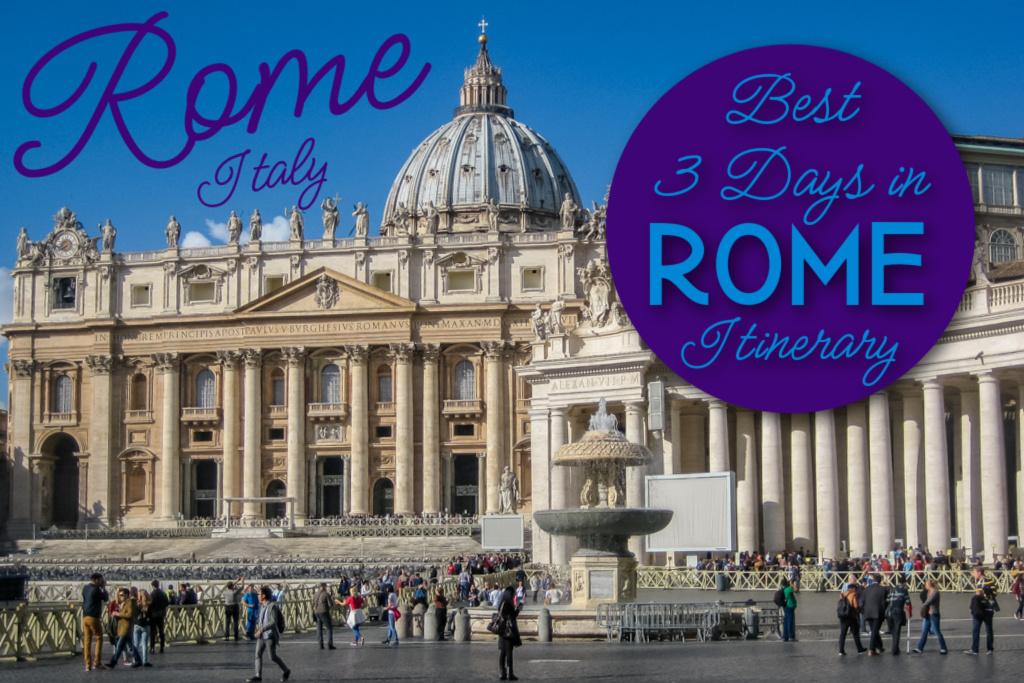
With iconic sights, amazing food and ancient ruins, Rome, Italy is a must-see European destination. Spending 3 days in Rome is just enough time to experience the highlights – but only with a good travel plan!
Don’t worry; we’ve got it covered. We have created an ideal 3 Day Rome Itinerary that is packed with top attractions, delectable eats, sightseeing tips and honest advice!
Our site utilizes Affiliate Links. If you use them to make a purchase, we may earn a commission. For more information, read our Disclosure Policy.
Planning 3 Days in Rome Itinerary
We believe The Eternal City should be on every Italy Itinerary. The fascinating history, beautiful architecture and incredible food make the city one of the best in the world.
That said, planning what to do in Rome for 3 days is not an easy task. Ancient attractions and must-see neighborhoods are far flung, which can make planning an efficient itinerary somewhat of a conundrum.
However, with proper planning it’s possible to experience the best of the city in 72 hours – and we’ll show you how!
Rome in 3 Days Itinerary Summary
With three days in Rome, you have just enough time to take in the best attractions. The sights we include are: Roman Ruins, Vatican City and picturesque neighborhoods.
On the first day you will visit the Colosseum, the Forum, the Pantheon and more top spots that are located in the heart of the time-honored city.
On the second day, step inside St. Peter’s Basilica, look up at the world-famous Sistine Chapel and visit Castle Sant’Angelo. Then, end the day on a fantastic food tour.
The last day of the trip features two of the best places to visit in Rome: the beautiful Villa Borghese and the fun Trastevere district.
Our Rome trip plan is organized in a day-by-day outline. For each sight, we include a brief description and tips for visiting. Additionally, we offer dining recommendations and a helpful map.
When planning what to see and do in Rome, organization is key. Use our Travel Planning Printables to keep track of your Vacation to Europe!

3 Days in Rome Itinerary

Are you ready to visit all the prime sights that Rome has to offer? Alright, let’s get started then!
DAY 1 – Roman Ruins and Iconic Sites

Any Rome travel itinerary wouldn’t be complete without touring these 2,000-year-old ruins!
Morning in Ancient Rome

Start your 72 hours in Rome seeing the oldest and most impressive areas: Palatine Hill, Roman Forum and The Colosseum.
They can all be visited on a combination ticket. It’s best to buy it online in advance from the official website. For the purpose of this 3 Day Rome Trip Plan, we recommend the 24-hour pass.
When purchasing the ticket, choose the time that you want to enter the Colosseum, but plan on visiting Palatine Hill and the Roman Forum first.
Expect to spend about 3 hours total at these historic Roman places. To time your Colosseum entry, plan a combined 1.5 to 2 hours at Palatine Hill and the Forum.
Palatine Hill

This is one of the Seven Hills of Rome and the oldest part of the city. The elevated settlement overlooks Circus Maximus and the Roman Forum.
While little remains of the original structures, you can see the outline of the grand palaces that once stood here and take in the incredible vantage points.
Pro Tip: Use this entrance at 30 Via di San Gregorio.
Roman Forum

Once the city center, today only pieces of columns, temples and buildings remain. Walk along the ‘streets’ where it feels a bit like stepping back in time.
Pro Tip: Palatine Hill and the Roman Forum are connected, simply use the path that leads to Arco di Tito (Arch of Titus).
The Colosseum

The city’s most iconic sight was built in the year 80 AD. The 2,000-year-old amphitheater was used for Gladiator fights, which entertained crowds of 50,000 people.
Pro Tip: While the basic combo ticket gets you into the Colosseum, there is little information once inside. You can book Colosseum Tours with a guide and get access to more areas.
Lunch at Pizzeria della Madonna dei Monti
When you leave the Colosseum, walk along Via Dei Fori Imperiali Road. The Roman Forum sits to the south and the Forum of Augustus, Trajan’s Forum and Column and the Mercati di Traiano Museum to the north.
Now make your way to Pizzeria della Madonna dei Monti for a simple lunch. The pizzas are priced by weight and wrapped to-go, which you will want to do because there is so much more to see!
Afternoon in Central Rome

Now discover additional sights in the city center. Trek up to Capitoline Hill, visit a stunning church and stand atop the Victor Emmanuel National Monument.
Then, stroll through beautiful city squares, gaze in wonder at the Pantheon and indulge in your first gelato!
Piazza del Campidoglio on Capitoline Hill

This area is the center of the city’s government. It was designed by Michelangelo in 1536 and the centerpiece is an equestrian statue of Marcus Aurelius.
The grand piazza is ringed by museums, including the Capitoline Museum, that exhibits fantastic artwork. However, we recommend skipping it unless you have more time.
Pro Tip: Walk around the south side of the square for a phenomenal elevated view over the Forum!
Santa Maria in Aracoeli Basilica

Located on the highest point of Campidoglio Square, this church is one that shouldn’t be missed! The over-the-top, glittering interior is sumptuously decorated and houses numerous artworks.
Pro Tip: It’s free…you just need to climb the 124 marble steps to the entrance!
Victor Emmanuel Monument

Formally called Altare della Patria, or Altar of the Fatherland, this momument celebrates Italy’s first king with a 43-foot-tall equestrian statue. At the base is the Tomb of the Unknown Soldier.
Pro Tip: You can go up to the Terrazza delle Quadrighe, but a ticket is required.
Piazza Venezia

On the north side of the Victor Emmanuel is Piazza Venezia. The ornate square is lined with palaces and Napoleon’s mother lived in one of them.
Nearby is the San Marco Church, which dates to the year 1336. If time allows, pop inside to see the extravagant mosaic interior.
Largo di Torre Argentina

This 3rd century BC holy site was only discovered in 1927. The remains of four Roman temples and the Pompey Theater – where Julius Caesar was assassinated in 44 BC – stand in the sunken square.
Pro Tip: Cats have long been the only creatures to walk among the ruins – humans only had a view from above. However, some of the walkways are now open to visitors for a fee.
The Pantheon

Another symbol of Rome, the Pantheon is an ancient wonder. Built as a temple for “all of the gods”, the structure is the best-preserved monument from Roman times.
The building, which is now a church, features a striking dome, which ranks as the largest unenforced concrete dome in the world.
Pro Tip: The Pantheon is no longer free to visit. Tickets can be purchased online or at the door.
Giolitti Gelato

Giolitti is one of the best gelato shops in Rome! The prominent gelateria has been in business since 1900. In addition to the standard flavors, they also make a rice gelato (and it’s actually quite good).
Pro Tip: There will likely be a line, but it moves pretty fast!
Evening on Day 1: City Squares and a Fine Italian Meal

End your first day with a leisurely stroll through the heart of Rome. While wandering, make your way to two of the city’s best squares.
Piazza Navona

This grand piazza is laden with outdoor cafes and features three ornate fountains.
Fontana dei Quattro Fiumi (Fountain of the Four Rivers) stands in the center and is flanked by Fountain of Neptune to the north and Fontana del Moro (Four Tritons) to the south.
Pro Tip: The outdoor cafes at Piazza Navona are perfect for enjoying a glass of wine while people-watching!
Campo de Fiori

Once a meadow, then a site for executions, Campo de Fiori (Field of Flowers) was transformed into a marketplace in 1869. During the day, the space still hosts a fresh produce market (except Sundays).
Pro Tip: At the center is a haunting statue of philosopher Giordano Bruno. In 1600, he was burned alive after being found guilty of heresy by the Roman Inquisition.
Dinner: Osteria da Fortunata
This traditional Roman tavern offers an excellent Italian gastronomic experience.
The pasta is made by hand and dishes are prepared with secret recipes. It’s incredibly popular and they do not take reservations, so expect a queue.
Top Tip: After dinner, take a stroll to Trevi Fountain and Spanish Steps. We visit these again on Day 3, however, they are extremely atmospheric and less crowded at night.
DAY 2 – Sant’Angelo Castle, The Vatican and Food Tour

Day 2 of your Rome trip explores the fascinating district of Prati, the renowned Castel Sant’Angelo and the legendary Vatican. In the evening, embark on a indulgent foodie excursion!
Morning in Prati and Sant’Angelo Castel

Begin in the Prati District. The underrated and affluent enclave is still somewhat off the beaten path. To get here, ride Metro Line A to the Lepanto Station.
Start with a classic Italian coffee and then stroll to the riverside castle. Then, eat an early lunch, as you will want to be hungry for your evening outing!
Sciascia Caffè 1919
This longstanding, award-winning cafe serves a secret blend of coffee that pairs perfectly with their cornetto pastry or light breakfast.
Pro Tip: Don’t rush through your coffee! Take a seat and enjoy every last drop, just like the Italians do.
Castel Sant’Angelo

Impossible to miss, this striking stronghold rises from the banks of the curving River Tiber.
Built in the 2nd century AD as a Mausoleum for Roman Emperor Hadrian, it has also been used as a fortress and a prison. Today the round, imposing structure serves as one of the best Rome museums.
Early Lunch at Scialla The Original Street Food
Grab a quick and light lunch, as dinner will be a proper feast, Pop into Scialla for suppli – a favorite Rome street food. Similar to Sicilian arancini, they are fried rice balls with tasty fillings. Try the Suppli all’Amatriciana!
Afternoon at the Vatican

Now head straight for Vatican City; it’s the world’s smallest country…but you don’t need a passport! Ruled by the Pope, the 121-acre nation boasts magnificent sights.
St. Peter’s Square

St. Peter’s Square is the massive plaza that fronts St. Peter’s Basilica. It was designed by famous Roman architect Gian Lorenzo Bernini. At the center of the vast space is an Egyptian obelisk.
A queue of people often wrap around the perimeter; it’s the queue for security checks before entering the church. (Hop in line, it moves fast – and admire the area while waiting.)
Pro Tip: If it happens to be a Sunday, the Pope speaks from his balcony window at noon.
St. Peter’s Basilica

Considered the largest church in the world, St. Peter’s is an awe-inspiring sight. Famous artwork – including The Pieta by Michelangelo – is housed inside.
Visitors can also see the burial site of St. Peter (one of Jesus’s apostles and the first Pope) or climb to the top of the dome (for a fee).
Pro Tip: Audio guides are available for a fee, but those interested in learning more can book a tour.
Vatican Museums & Sistine Chapel

The museums at the Vatican host a massive collection of the world’s most impressive masterpieces, including the incredible Gallery of Maps.
However, the Sistine Chapel (no photos allowed) is the highlight. Best known for its ceiling painted by Michelangelo titled “The Last Judgement.”
Pro Tip: Tickets are required to enter and we suggest buying them online in advance to skip the line or join a tour.
Evening Rome Food Tour
Although known for its exceptional cuisine, it’s not always easy for tourists to find authentic restaurants in Rome.
On this highly rated Rome Food Tour in Trastevere, you are treated to more than 20 tastes of local dishes – plus free-flowing wine!
Alternate Evening Plan

While food tours are a fun way to spend an evening, we know that some travelers are more interested in the sights.
Rome is a haven of famous religious landmarks, and those interested in seeing more should consider visiting San Giovanni in Laterano and Scala Sancta.
To get to there from the Vatican, hop on the Metro Line A at Ottaviano and disembark at San Giovanni.
Church of San Giovanni in Laterano
Unknown to many tourist, San Giovanni in Laterano is the Cathedral Church of Rome and the official seat of the Pope (making it ‘higher ranking’ than St. Peter’s Basilica).
The building, which features a striking facade, is one of the oldest churches in Rome and the interior is lavishly decorated.
Pro Tip: It is free to enter, but a ticket is required for the museum and 13th-century cloister.
Vatican Holy Stairs
Made of white marble covered in wood, these steps are believed to have been walked on by Jesus during The Passion. They were relocated from Jerusalem to Rome in the 4th century.
Pro Tip: Pilgrims can climb the steps, but only on their knees. At the top is the Sancta Sanctorum – or the Holy of Holies – which is a small chapel once used by Popes.
Dinner at I Buoni Amici Roma
Slightly off the beaten path, this neighborhood restaurant serves spectacular dishes. The staff are friendly and welcoming – and it’s affordable, too!
While the Tonnarelli Cacai e Pepe gets rave reviews, we suggest ordering fresh seafood or Saltimbocca alla Romana (Roman-style veal cutlets).
Day 3 – Villa Borghese, Trevi, Tiber and Trastevere

Day three of our Rome tour itinerary explores more iconic places in the city. You will want to wear your favorite walking shoes, because we cover a lot of ground today!
Morning in Villa Borghese and nearby Attractions
Get an early start and fuel-up for your day with a classic beverage at a historic coffeehouse.
Then, enjoy the relative calm at popular sights that are not yet crowded with fellow tourists. Next, make your way to the famed Piazza del Popolo and Villa Borghese Park.
La Casa del Caffè Tazza d’Oro
Many cafes serve Coffee Granita, but no place is more famous for this specialty than this place. Known for their icy espresso topped with cream, it’s the perfect way to kickstart your day!
Top Tip: They open at 7am on weekdays and Saturdays. However, like many places in Rome, it opens later on Sundays; at 10am.
Trevi Fountain

One of the world’s most famous fountains, the enormous Baroque Trevi dates to the year 1762.
It is believed that tossing a coin into the water (with your right hand over your left shoulder) will guarantee a return visit to Rome. So, go ahead and give it a try!
Spanish Steps

Built in the 1700s, these 135 stairs connect the Spanish Embassy to Trinita dei Monti Church. At the base, in Piazza di Spagna, is the Fontana della Barcaccia (Fountain of the Ugly Boat).
Pro Tip: While an attraction, they are also a place to rest, relax and meet fellow travelers!
Piazza del Popolo

A grandiose neoclassical square, this space once served as the northern entrance into the city of Rome. It features elaborate fountains, twin churches and an ancient Egyptian Obelisk at the center.
Top Tip: To get to Piazza del Popolo, use the popular walking street, Via del Babuino. The charming throughfare is lined with high-end stores and boutique shops.
Villa Borghese

Serving as Rome’s largest green space, the ornate Borghese Park is crisscrossed with walking paths and is adorned with sculptures, monuments and artwork.
Plus, it hosts top attractions (including museums and a zoo) and the lakeside Tempio di Esculapio is not to be missed!
Top Tip: The Borghese Gallery – which features the work of Bernini – is a must for art aficionados.
Afternoon in Trastevere and Tiber Island

Now make your way towards the Trastevere neighborhood. Eat Rome’s best sandwich, then stroll to the Jewish Quarter, Bocca della Verita and on to Tiber Island.
Trastevere

Trendy Trastevere lies on the west bank of the Tiber River. With narrow lanes and picturesque squares, it is one of the most atmospheric neighborhoods in Rome.
We are highlighting a few must-sees, but suggest also just wandering with a sense of wonder and see what you discover!
Lunch at Cabullo (and Gelato)
For lunch eat the famous Rome pork sandwich, a Porchetta Panini, at Cabullo. The savory slow-roasted pulled pork is piled high on a soft bun. It’s simple and it’s divine.
Just be sure to save room for dessert – as the area is best explored with gelato in hand! We recommend getting a scoop from the nearby Gelateria del Viale.
Top Tip: If it happens to be the weekend, check out the Mercato Campagna Amica al Circo Massimo market, too!
Church of Santa Maria Trastevere

One of Rome’s oldest churches, it dates to the 3rd century (although it was rebuilt in the 12th century). The interior features intricate mosaics.
It is free to enter, but don’t miss the facade, which is decorated in glittering mosaics and a rising Romanesque bell tower.
Jewish Quarter
The Roman Ghetto dates to the mid-1500s, when the Pope stripped Jews of their rights and designated that all Roman Jews live within the confinements of the district.
In 1943, the Nazis descended on the neighborhood, sending more than 1,000 Jews to their death at Auschwitz.
Today, the area thrives as a quaint neighborhood. It is home to the Great Synagogue of Rome, the Jewish Museum and an incredible number of restaurants.
Pro Tip: To get to the Jewish Quarter, start by crossing the pedestrian-only Ponte Sisto bridge.
Bocca della Verita

The Mouth of Truth is a sculpture dedicated to the God of the Sea (whose eyes, nose and mouth are open).
Legend says it will bite off the hand of liars, so tourists line up to prove their honesty (or test the legend).
Top Tip: The Bocca della Verita is located on the facade of Santa Maria in Cosmedin Basilica, which is worth a quick look inside. Also nearby is the Temple of Hercules Victor.
Tiber Island

Only 890 feet long and 220 feet wide, this island lies in the middle of the Tiber River. It’s mostly occupied by a hospital, but the Basilica di San Bartolomeo all’Isola is worth visiting.
Pro Tip: You can easily get here from both banks of the river via bridges. In fact, the northside Ponte Fabricio is the oldest bridge in Rome, dating to the year 62 BC.
Evening in Trastevere

Spend the evening of your last night in Rome back in Trastevere. First, hike up to an elevated perch for a fabulous panoramic vista, then dine at a top restaurant.
Gianicolo Hill

Providing sweeping views over Rome, Gianicolo Hill – also called Janiculum – is a stunning place to go at sunset.
Although the viewpoint faces the opposite direction, it’s a phenomenal vantage point to see the city bathed in soft light. It is also home to churches, universities and the Baroque Fontana dell’Acqua Paola.
Pro Tip: If time allows, seek out the Church of San Pietro in Montorio, the Garibaldi Monument and the Manfredi Lighthouse.
Dinner at Mimì e Cocò Trast
Stylish, yet warm, this eatery is housed in a wonderful 18th century building. The menu features classic Italian dishes and the ambiance is supreme.
Go for the Lasagna Bolognese and Spaghetti alla Carbonara…and maybe a bottle of Italian red wine. Ciao, Italia!

Rome Attractions Map
Use this Google Map for an interactive version of our Rome Map for Tourist below. BLUE markers are Day 1; PURPLE Day 2; GREEN Day 3; GRAY indicates alternate options.

Top Tours for Travelers to Rome

Trying to plan what to visit in Rome in 3 days is a big task! Hopefully, we have helped you decide how to spend your time in the city.
We are fairly independent and like to move at our own pace. However, figuring out exactly where to go, how to get there and what to see can be stressful.
Those who would rather leave it to a professional might consider adding tours to their Rome sightseeing itinerary.

There are hundreds of Rome tours to choose from. Our advice is to research ahead of time and thoroughly read reviews.
After selecting one, make sure to book your spot in advance. The most popular tours book up quickly!
Ancient Sights and Colosseum Half Day Tour
Rather than tackling Old Rome on your own, let a guide lead the way! A professional provides insight about the historic sights, which can certainly enhance the experience.
Vatican Tour
On this 3-Hour Vatican Highlights Tour, participants are led by an expert guide through the massive complex.
They showcases the most important pieces inside the museum and help you to better understand the Sistine Chapel. It also includes a guided walk through St. Peter’s Basilica.
Hop On Hop Off Bus
While we love walking around Rome, not everyone agrees with us! If pounding the pavement isn’t appealing to you, consider hopping aboard this Big Bus Tour.
Day Trips from Rome
There are plenty of places to visit in Rome without leaving the city center. However, there’s quite a few amazing locations you can easily reach on Rome day trips, too!
Our Rome Travel Tips

We have provided our recommendations for the top things to do in Rome in 3 days, and we believe it’s a pretty solid plan! However, we do have some advice to share that will aid in your vacation planning.
When To Go to Rome
Before planning a Rome trip, consider the weather, crowds and prices – and which is most important to you.
There are pros and cons to visiting Rome any time of year, and there really isn’t an off-season any longer. That said, we believe it is best to visit Rome in the fall.
During autumn, temperatures have backed off and so have the crowds. Wintertime can be chilly and wet. Spring is not a bad time to go, just avoid the week of Easter!
Summertime sees the heaviest crowds, the highest prices and soaring temperatures. If at all possible, say no to Rome in the summer.
How To Get to Rome
Leonardo da Vinci Fiumicino Airport (FCO) is the main airport in Rome and handles the majority of international flights. Rome Ciampino Airport (CIA) is served by low-cost carriers Ryanair and Wizz Air.
Both are connected by express trains. Roma Termini, which is conveniently right in the city center, is the primary rail hub.
There are multiple bus stations in Rome; the biggest sits right outside of Termini. Those visiting Rome by cruise ship will dock at the Port of Civitavecchia, northwest of the city.
Where To Stay in Rome
There are thousands of places to stay in Rome and consequently we have stayed in numerous different places.
While we don’t have a singular Rome hotel recommendation, we prefer the area around the Barberini metro stop.
It’s best to start your search on a robust search engine, like Booking.com. First, however, read our tips for Finding Prime Hotels for Cheap!
What To Pack For Your Trip to Rome
 Okay, it’s finally time to get out that backpack or suitcase. So, grab our FREE Checklist and let’s get you to Italy!
The Right Clothes
It is important to pack clothing that is comfortable for sightseeing in Rome – but it’s also necessary to wear appropriate apparel. Most churches require your knees and shoulders be covered.
I suggest women wear comfortable knee length dresses in summer. Additionally, carry a wrap or hoodie to cover shoulders if necessary.
Walking Shoes for Europe
Our itinerary for Rome in 3 Days will require some steps! It’s important to pack durable travel shoes. I like wearing these trainers from New Balance and Kris prefers trail shoes by Merrell.
Travel Camera
Between the ancient ruins and stunning architecture, Rome is a magnificent city to photograph. We recommend having an actual travel camera and keeping your phone tucked away.
We shoot with a Canon Rebel and a 18-135mm lens, which captures great shots and the kit comes with loads of accessories, making it a great budget camera!
Rome Weather Gear
Many of the attractions in Rome are outdoors, so it is best to be prepared for the elements. It’s a good idea to bring a packable raincoat and travel umbrella (which can also provide shade on sunny days).
In the summer, make sure to pack sunscreen and a wide-brimmed hat – and your favorite sunglasses.
Zippered Day Bag
The city of Rome is rife with pickpocketing thieves. We like to carry these small backpacks and wear them on our chests in crowded spaces.
They can hold our collapsible water bottles and other everyday travel items. Read our reviews for the Best Day Bags for Travel to find the right one for you!
Italy Travel Insurance
No matter how well you prepare, sometimes travel goes sideways, Luggage gets lost, flights cancel or travelers become ill. If you haven’t already, consider traveling protected with World Nomads.
Start planning your trip to Italy! Search for the lowest airfares, the best accommodations and fun things to do…then start packing! Want additional advice? Head over to our Travel Planning Page and for country-specific information, take a look at our Travel Guides Page!
Italy Travel Guides

Hopefully you found our article on how to visit Rome in three days to be helpful. Check out our other honest and free travel guides for Italy!
- Best Itinerary for Florence
- Top Florence Travel Tips and Where To Eat
- Things To Do in Siena
- One Day in Venice
- Free Milan Walking Tour
- Visiting Bergamo
- Top Sights of San Gimignano
- Lucca Italy Things To Do
- 1 Week Tuscany Itinerary
- Things To Do in Lecce, Puglia

Pin it! See all of our travel pins on our JetSetting Fools Pinterest Board.
