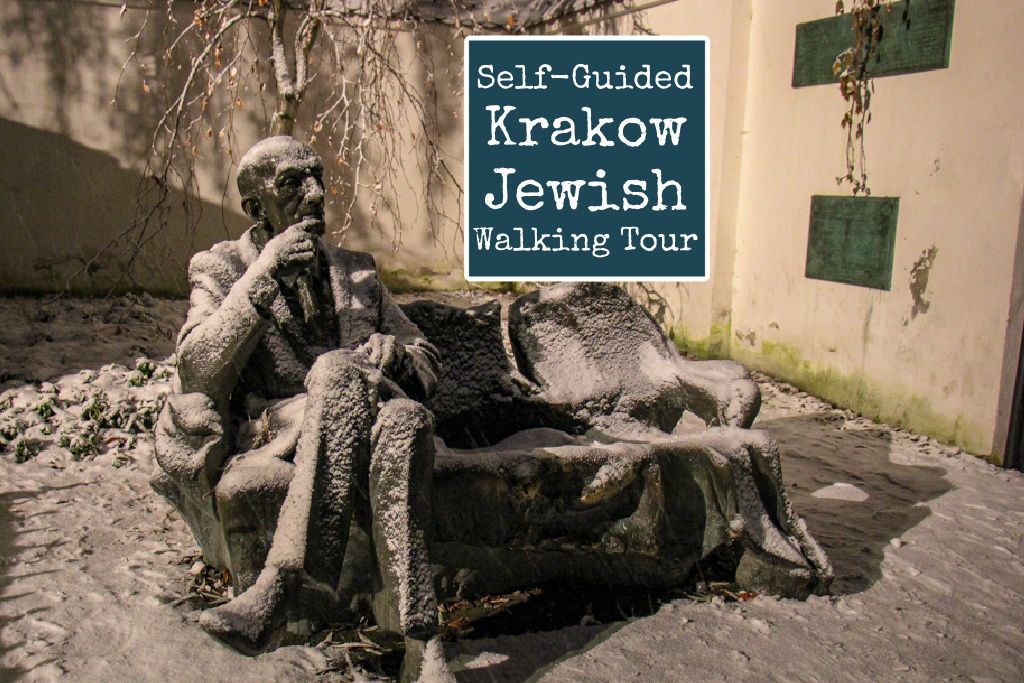
Krakow’s Jewish heritage is both beautiful and haunting. We experienced a full range of emotions as we toured the Jewish Quarter and former Ghetto.
It’s a part of history that can be difficult to grasp without setting your feet on the ground, which is exactly why we created this Free Krakow Jewish Walking Tour.
Our site utilizes Affiliate Links. If you use them to make a purchase, we may earn a commission. For more information, read our Disclosure Policy.
Discovering these districts is a must when visiting Krakow – and this self-guided walk fits perfectly into our 3-Day Itinerary.
Krakow Jewish Walking Tour Details
On this walk, you will navigate to the places where Jews once lived and sites where atrocities occurred. As you move at your own pace, you will be able to put together the pieces of the complicated past.
Our Krakow Self-Guided Jewish Walking Tour is nearly 4 miles in length and will take approximately 3-4 hours to complete. (Budget a few hours more if you plan to visit Schindler’s Factory Museum.)
The route delves deep into Kazimierz (the Jewish Quarter) and Podgorze (the former Jewish Ghetto). It is designed in a loop, with the final stop just a short distance from where we start.
For directions, we have provided a map link for each attraction – plus, we share an overview of the route later in the article.
Note that many sights on our Jewish Walking Tour of Krakow (including synagogues, cemeteries and museums) require entry fees (often paid in cash). However, going inside is not necessary to grasp the importance of the place.
We enjoyed exploring the historic districts on our own, but you can also join guided Jewish walking tours – like this one.
If you want to discover more of this historic city, this route is a great extension to our Old Town Krakow Walk.
What You Need for this Krakow Jewish History Walk
Before you set off, you will want to make sure you are prepared with the necessities.
Comfy Shoes: Wear your favorite travel shoes; I like everyday trainers and Kris wears trail shoes.
Day Bag: Bring a zippered day pack that is big enough to neatly stow everything you’re carrying.
Travel Camera: We use a DSLR Canon Rebel; it’s a solid choice for budget travelers.
Local Currency: If you plan on visiting sights with admission fees, bring Polish Zloty in small change.
Power Bank: Don’t forget your portable battery for a mid-tour boost!
Wi-Fi: You must have connectivity to get directions. If traveling from abroad, upgrade to an international plan, buy an eSIM or use a Pocket WiFi device (we like GlocalMe).
Want an ad-free version of this walk? You can buy the PDF for less than the cost of a paczek donut!
Self-Guided Krakow Jewish Tour

There is a lot to see, learn and process on this walk, so let’s get started straight away.
Kazimierz District

Established in the 14th century when King Casimir the Great granted Jews the right to trade and freedom of religion, Kazimierz blossomed as the Krakow Jewish Quarter.
It was here that many Jewish people lived, worked and prayed until they were forcibly moved into the Krakow Jewish Ghetto in 1941.
Even though much of the area was destroyed during Nazi occupation (and what wasn’t was left in ruins), the district has retained much of its early history and culture.
Kazimierz has also evolved into one of Krakow’s lively nightlife districts and features many famous street art murals.
#1 Tempel Synagogue
MAP. We couldn’t think of a more appropriate place to begin this self-guided walking tour of the Jewish Krakow Quarter than at a synagogue.
Standing proudly on Ozjasz Thon Square, Tempel Synagogue was built in the 1860s. Yet, of all the Krakow synagogues, it is the youngest.
The most distinct feature of the façade is the black marble tablets featuring the Ten Commandments.
The interior, although slightly run down, still glimmers with a gilded ceiling. A cash ‘donation’ is required for entry and a factual pamphlet is provided.
#2 Szeroka Street

MAP. This is the main thoroughfare in the Krakow Kazimierz Jewish Quarter. The name means ‘Wide Street,’ which makes sense, because it feels more like a long, rectangular square.
Home to multiple synagogues and dedicated Jewish shops, it was once the beating heart of the local community.
Today, you will find several Jewish heritage buildings – along with revitalized stores, statues and memorials. One notable statue is of a man sitting on a bench; it honors Jan Karski.
A Polish resistance fighter and WWII diplomat, he is known as the ‘man who tried to stop the Holocaust.’ He infiltrated ghettos and concentration camps to unveil the horrors that were being committed.
#3 Remuh Synagogue and Old Jewish Cemetery
MAP. Standing as the most sacred Jewish site in Krakow, Remuh Synagogue can trace its history to the year 1558 – which makes it one of the oldest synagogues in the city.
The required cash ‘donation’ includes the adjoining Remuh Cemetery. The burial grounds are the final resting place for many famous Jews from Krakow (although Nazis destroyed most of it during occupation).
#4 The Old Synagogue
MAP. Built in 1407, this is the longest surviving synagogue in Poland. It has endured destructive fires, massive renovations and looting during war.
Transformed into a museum in 1958, it stands a symbol of history, tradition and faith for the Jewish people of Krakow.
For visitors, it provides an opportunity to learn about the Jewish culture. Tickets are required to enter.
#5 Plac Nowy and Okraglak
MAP. Continue your walk in the Krakow Jewish Quarter to Plac Nowy – or New Square. Sometimes referred to as the Jewish Square, the plaza has long served as the Kazimierz marketplace.
Although it is fairly small in terms of market squares today, it remains a popular Krakow gathering place at all hours, day or night.
Market booths stand on the perimeter, while a large rotunda – called the Okraglak – takes up the center space.
The round building was originally used as a chicken slaughterhouse and is listed on the register of Historical Monuments of Krakow.
Today, vendors sell zapiekanka (a Polish toasted baguette) from the windows. The cheap and filling street food makes a great snack or meal-on-the-go.
#6 Schindler’s List Passage
MAP. Although not necessarily a Jewish heritage attraction, Schindler’s Passage is a narrow courtyard made famous as a filming location for Schindler’s List.
It’s actually one of many locales in Krakow that appear in Steven Spielberg’s Oscar-winning 1993 motion picture.
The passageway posed as the Jewish Ghetto (the real one had been destroyed) and was used in several scenes in the movie – including the ‘Ghetto Liquidation’ scene.
Inside the courtyard, you will find a few informational plaques, as well as some restaurants and bars.
#7 Corpus Christi Basilica
MAP. A Catholic church in the historic Jewish district, Corpus Christi is a testament to Krakow’s long-standing tradition of tolerance and co-existence.
The dominating structure was established in 1340, but was gradually expanded and enhanced through the centuries into the Gothic marvel it is today.
Its free-standing tower – which was built in the middle of the 16th century – is the most distinctive architectural feature.
Although stern on the outside, the interior is a bedecked in sumptuous Baroque gilding. Don’t miss the colossal organ; it has 5950 pipes (some of which date to the 1770s).
#8 Bernatek Pedestrian Bridge

MAP. The modern Bernatek Bridge straddles the Vistula River, connecting Kazimierz and Podgorze.
The crossing – sometimes called Father Bernatek Footbridge – is named for a monk who founded a local hospital.
The bridge was built in 2010 and features acrobatic figures on the cables – making it a fun spot for photo ops.
Podgorze District

Podgorze is another one of the places in Krakow marred by a dark and disturbing history.
For centuries, it functioned independently, but was finally incorporated into the city of Krakow in the beginning of the 20th century.

In March 1941, the Nazis designated part of the district as the Jewish Ghetto. Krakow’s Jews were forced to live in cramped quarters behind walls, separate from the rest of society. Two years later, they murdered the entire population.
During this part of our self-guided Jewish Walk, we explore remnants of the past and poignant memorials.
#9 Podgorski Square

MAP. Established in the 1780s, Podgorski Square is a triangular-shaped plaza in the historic center of Podgorze.
Marking the crossroads of important trade routes, it boasted a bustling marketplace and has long housed the seat of local government – the New Town Hall is at #1.
Most eye-catching, however, is St. Joseph’s Church. Dating to the early 1900s, the Gothic Revival style church (along with its dominating clock tower) is the centerpiece of the plaza.
In the 1940s, the Jewish Ghetto extended to this space. One of the main gates stood on the northeastern corner at Limanowskiego Street, by Town Hall.
Top Tip: Bar Mleczny Poludniowy – on the northwestern corner – is one of our favorite milk bars in Krakow. It’s a prime choice for a fast and cheap traditional lunch.
#10 Krakus Mound

MAP. This prehistoric tumulus is the oldest structure in Krakow. Standing 52-feet-tall, the man-made mound is fabled to be the burial place of King Krakus, the founder of Krakow.
A narrow, circular path winds around the mound to the top, where there are 360-degree views of Krakow and the surrounding region.
The vista encompasses three significant sites: Liban Quarry, remains of the Plaszow Concentration Camp and the New Podgorze Cemetery.

The limestone quarry opened in 1873, but the earthen pit now lies abandoned laden with rusting equipment. During Nazi occupation it was a place of forced labor and death (it also featured in Schindler’s List).
The Plaszow Camp, south of Krakus Mound, was established by the SS in 1942. The location was purposeful.
It occupied the sacred site of two still-active Jewish cemeteries – both of which were desecrated and destroyed. The tombstones were repurposed to pave roads and construct buildings.
Plaszow first functioned as a forced labor camp, then as a concentration camp. There were no gas chambers here; instead, mass murders were carried out by shootings.
To the southeast, you can see the New Podgorze Cemetery. Opened in 1900 – and with well-preserved gravesites and wooded grounds – it stands in striking contrast to the adjacent landscape.
#11 & 12 Krakow Ghetto Wall

MAP and MAP. The next two stops on our Krakow Jewish Ghetto Walking Tour are still-standing sections of the wall. Although mere fragments, they stand as evidence of the horrors that took place here.
The first fragment – which we think resembles a long line of tombstones – is found in a somewhat unusual place: a playground behind a school.
To reach it, go through the gate to the left of the school building at #62 Boleslawa Limanowskiego.
The wall fragment on Lwowski Street (next to #29) features a similar eerie grave-marker design.
The small plaque reads, “Here they lived, suffered and died at the hands of the German torturers. From here they began their final journey to the death camps.”
#13 Heroes Square

MAP. One of the most moving stops on our walk in Krakow’s Jewish District is Heroes Square. In 1941, this plaza – known then as Little Market Square – was at the heart of the Jewish Ghetto.
After the war, it was renamed Ghetto Heroes Square and, in 2005, the Empty Chairs Memorial was erected in honor of the murdered Jews. The chilling display of 70 illuminated chairs covers the entire space.
They are a symbol of both the furniture that was left behind, as well as the missing people who would be sitting in those chairs had they not been killed.
On the south side, find the Pharmacy Under the Eagle Museum (or Apteka pod Orlem).
In 1941, the owner – the only non-Jew working in the Ghetto – kept his shop running to aid inhabitants. Not only did he provide necessary medicine, but also fake documents.
#14 Schindler’s Factory Museum
MAP. No tour of Jewish Krakow would be complete without seeing Schindler’s Factory. Although it’s a museum today, it was a functioning factory during World War II.
Owned and operated by Oskar Schindler – a member of the Nazi Party – he employed Jews living in the Ghetto. Touting his workers necessary to his business and the war, his efforts ended up saving 1,200 lives during the Holocaust.
The Schindler’s Factory Museum details life in Krakow during Nazi Occupation from 1939 to 1945. A ticket is required to enter.
If you plan to visit, we recommend purchasing Skip the Line Tickets or joining a guided tour – like this one.
#15 Krakow New Jewish Cemetery
MAP. The cemetery on Miodowa Street – called Zydowski Cmentarz – is the final stop on our Jewish Krakow Walk.
Established in 1800, the 55-acre Jewish burial grounds suffered heavy damage during WWII.
Painstakingly restored, the cemetery contains 7,000 gravestones with inscriptions in Hebrew, Polish and German. A memorial to Holocaust victims stands near the funeral home.
The forested grounds are a peaceful place for reflection and a moment of solitude before continuing your exploration of Krakow.

Map of Krakow Jewish History Tour
Use this Google Map for an interactive version of our Krakow map below.

After Your Jewish Krakow Tour

We hope our tour of the Krakow Jewish Quarter and Ghetto was helpful and enlightening.
It is just a short walk back to Szeroka Street or Temple Synagogue, where you can continue discovering on your own.
Alternatively, hop on a tram to Krakow Old Town. If you haven’t yet toured the historic center, use our Free Walking Tour for the best route through the city.
Start planning your trip to Poland! Search for the lowest airfares, the best accommodations and fun things to do…then start packing! Want additional advice? Head over to our Travel Planning Page and for country-specific information, take a look at our Travel Guides Page!
More Top Poland Destinations
- The Best of Warsaw in 3 Days
- How To Spend 3 Days in Gdansk
- What To Do in Wroclaw
- Must-Eat Polish Food (and Best Wroclaw Restaurants)
- What To See in Poznan in a Day

Pin it! See all of our travel pins on our JetSetting Fools Pinterest Board.
