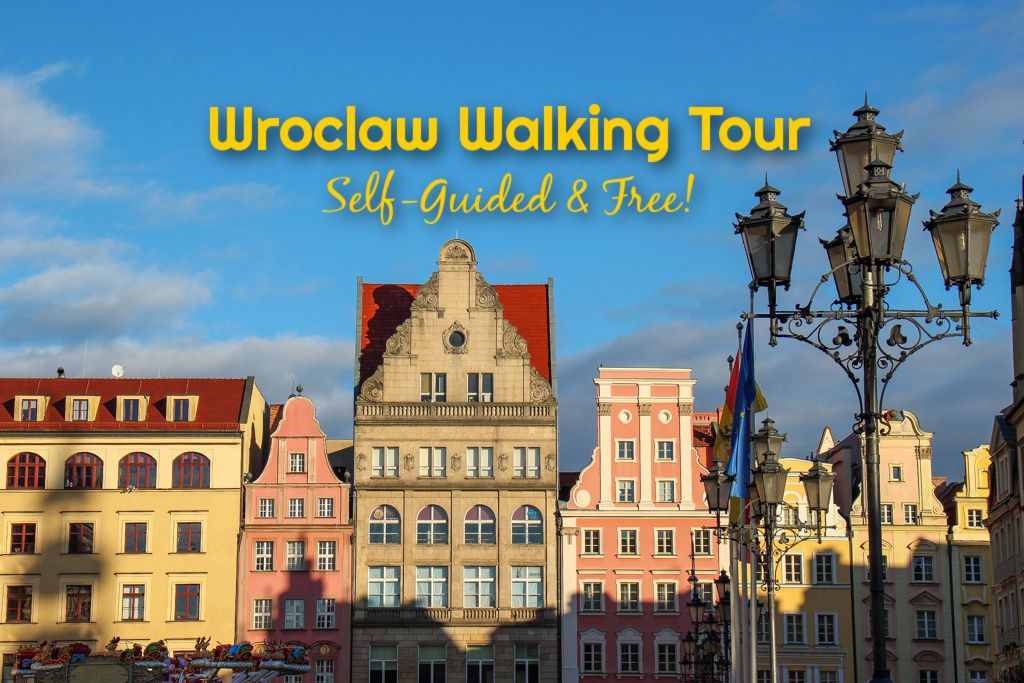
Wroclaw, Poland is a city that has a story to tell – and the best way to listen to it is by strolling the streets.
Each lane is a turn of the page, every vibrant square a new chapter. The main characters are the sensational sights, architecturally gorgeous buildings and unsuspecting gems.
Our site utilizes Affiliate Links. If you use them to make a purchase, we may earn a commission. For more information, read our Disclosure Policy.
During our stay, we spent time navigating many historic neighborhoods. Each one is unique, but none more enthralling than the historic center.
On our frequent Old Town walks, we routed our way through the heart of the city to the most magnificent attractions. This free, self-guided Wroclaw walking tour is our favorite course to take.
About Our Self-Guided Wroclaw Walking Tour
We believe touring on foot is one of the Best Things To Do in Wroclaw. The outlined route is about 4 miles long and will take 2-3 hours. Our Wroclaw walk is basically a loop; ending nearly where we begin.
At the end of the tour, you can opt to extend your exploration on an additional 2-mile trek to some lesser-known attractions.
Map links are provided for directions to each sight – and you will find a map of Wroclaw marked with all the stops later in the article.
This free Wroclaw walking tour is perfect for those who prefer to move at their own pace. For a more formal introduction, we recommend joining one of the guided Wroclaw tours, which we highlight later.
We also made this tour available in PDF (without advertisements); you can buy it here for the price of a Polish pączki donut!
Must-Haves for Your Walking Tour: Wroclaw, Poland
Before you set off on your jaunt through the city, there are a few things you will need.
Shoes: Wroclaw is flat, but the cobblestoned streets are uneven. Wear comfortable travel shoes; I like these everyday trainers and Kris wears trail shoes.
Camera: Bring your best travel camera – Wroclaw is stunning! We use a Canon Rebel.
Battery Boost: Don’t forget a portable power bank to recharge your phone.
Day Bag: Carry a travel day pack that is big enough to stow everyday necessities; we like these small backpacks.
Wireless Connection: For navigation, you will need connectivity. If traveling from abroad, upgrade to an international data plan, install an eSim (for unlocked phones) or buy a Pocket Wi-Fi Device, like GlocalMe, before your trip.
Wroclaw Walking Tour: Self-Guided
 Ready for your walk in Wroclaw, Poland? Okay, lace up those shoes and let’s get going!
#1 Rynek (Market Square)

MAP. Like most Wroclaw walking tours, ours begins in atmospheric Rynek. The massive, pedestrianized space is one of the largest market squares in Poland and the details are intriguing.
The history of Rynek stretches back to medieval times, when Wroclaw was part of the Kingdom of Poland. The first structures sprouted up in the mid-1200s, as the city was granted trading privileges by Magdeburg Law.
Through the centuries, Wroclaw fell under the control of Bohemia, Austria and Germany, to name a few. Each left their mark on Rynek, with various expansions, demolitions and renovations.
Now picture-perfect, the fairytale scene hosts some of the city’s biggest celebrations, like the annual Wroclaw Christmas Market.
Wroclaw History

To truly understand the tale of modern Rynek, you have to know a little about the history of Wroclaw.
During World War II, Wroclaw – then known as the German city of Breslau – became a Festung (or Fortress) for the Nazis.
Near the end of the war, the Soviet Red Army besieged the city and left it in shambles. Rynek, while heavily damaged, miraculously remained mostly intact.
At the war’s conclusion, the city fell within the new boundaries of Soviet-backed communist Poland and its name reverted to Wroclaw.
In an effort to promote a new identity, German residents were expelled and Polish citizens were welcomed back. Rynek was restored to its former glory, essentially erasing any evidence of the recent past.
Some recreations of the tenement houses were true to form, while others deviated vastly from their original plans.

The green structure at number 52 is emblematic of the entire square. Called the House Under the Golden Anchor, it ranks as one of the first brick homes to encircle Rynek.
It was built around 1240 and expanded generously in the 15th century. Then renovated again in 1567 in the Mannerist style, embellished in 1712 with Baroque elements and completely rebuilt in 1887 with a Neo-Renaissance flair.
Even though it was remodeled once more in 1936 and largely survived WWII, it was demolished and rebuilt in a style that was harmonious with the rest of the reconstruction.
Today, the vibrant, eye-pleasing facades on Rynek Square boast Classical, Baroque and Mannerist designs that are reminiscent of the early 1800s. However, none of these rainbow-colored buildings are original.
#2 Central Block at Market Square
 MAP. One of the unique aspects of Rynek is the Central Block. These structures in the middle of the square are sometimes referred to as the Mid-Market Block or the Tritt (or Tret or Tretu).
Their presence creates wide thoroughfares on each side, which is why the square is sometimes called The Great Ring.
Even more interesting is that the Central Block sits at a slight angle…and not by accident. The minor rotation was designed to create a more efficient flow for gatherings.
The first buildings here were merchant houses – and they stood as early as the 13th century. In these halls, vendors sold home goods, food, shoes and cloth.
The customs house, scales and Old Town Hall (which we look at in more detail next) were also located within the complex.
When the outdated market halls were demolished in the 1820s, tenement homes were built in their place. Today, the cobbled lanes evoke medieval charm and are fun to just wander along.
#3 Wroclaw Ratusz

MAP. Next up on our walking tour is the famous Ratusz – or Old Town Hall. Built in the center of the square, adjacent to the original merchant halls, it stands as a city landmark.
Construction commenced in the year 1299…but in the following centuries it was consistently enlarged, enhanced, repaired and remodeled into a Gothic treasure.
The clocktower reaches a height of 215 feet and the oldest bell in Poland (dating to 1368) hangs inside.
On Sundays at noon, a trumpeter plays the Wroclaw Bugle Call from the tower – a tradition that has been going strong since 1601.

The Pillory standing in front of Old Town Hall was a place for punishment during medieval times. Criminals were chained to the pillar and ridiculed, beaten and – sometimes – executed. (This one’s a replica.)
To the south is the entrance to Piwnica Świdnicka. The basement restaurant dates to 1303 and is considered to be one of oldest in Europe. (It was first an inn, then a beer hall.)
Here’s a fun fact: The brewery was located directly across at Number 22 Rynek in the House Under the Golden Jug. The beer was transported directly into the pub via an underground tunnel!
The nearby sculpture, called Rzeźba Niedźwiedzia or Bear Fountain, was placed here in 1904. At the time, it actually functioned as a water source.
The original bronze artwork was lost during WWII, but a replacement was unveiled in 1998. It’s considered good luck to rub the bear’s tongue!
Old Town Hall also houses the Museum of Bourgeois Art. A ticket is required for entry, but the interior is quite impressive if you have the time.
#4 Monument of Aleksander Fredro

MAP. There are so many fascinating stories within Wroclaw’s tangled history – and the Aleksander Fredro Monument is one of them.
Fredro was born Polish…but for most of his lifetime (1793 to 1876), Poland as a country did not exist. Regardless, he wrote poems, plays and books in his native language.
His statue was built and displayed in Lviv, where he spent his final years. Only in 1956 did it come to Wroclaw.
The sculpture of the beloved national figure was placed on the same spot as the destroyed statue of Frederick William III of Prussia (a lingering memory of Germany).
The Monument of Fredro is a symbol of Polish pride…and a popular meeting place for locals.
#5 Plac Solny (Salt Square)

MAP. A miniature version of Rynek – and connected at their corners – Plac Solny was established as a secondary marketplace in 1242 after the Mongol Invasion.
Here, they sold honey, leather and precious salt that was excavated from the Wieliczka Salt Mine near Krakow. And just like Rynek, it has a storied past.
In 1453, during the ‘Bonfire of Vanities,’ 41 Jews were burned at the stake. A slender spire commemorates the event.
In 1827, a statue of Blucher, a Prussian warrior, was erected in the center – and the space was renamed in his honor.
At the conclusion of WWII, that statue was destroyed, the name was changed back to Plac Solny and the whole area stylishly overhauled.

Today, the signature of the square is the small flower shops on the east side. Open 24 hours a day, they look even more stunning after dark.
An interesting – and unseen – sight is the subterranean bunker. Able to accommodate 300 people, the air raid shelter is now a museum of old movie props. There are also public toilets located underground. (Both require a fee.)
#6 Nowy Ratuse (New City Hall)

MAP. Continue your walking tour in Wroclaw by re-entering Rynek from Salt Square.
By the 19th century, the city had outgrown Old Town Hall – so New City Hall was built right around the corner.
Occupying the site of a former Merchant Hall in the Central Block, the three-story structure dates to the early 1860s.
The modern glass and granite Zdroj Fountain in front was installed in 1996 – but not without contention for its contemporary style.
Both the fountain and the Santander bank building (on the southwest corner) disrupt the balance and symmetry of Rynek. (Although, in our opinion, the fountain is far more forgivable!)
#7 Hansel and Gretel Houses

MAP. The two houses that stand at the northwest corner of Market Square are collectively – and lovingly – named the Hansel and Gretel Houses.
(Except in Polish they are called “Jaś i Małgosia,” – or John and Margaret – rather than the German equivalent.)
Linked by an arch, they appear to be holding hands, just like the classic fairytale characters. Although whimsical now, the 15th century buildings were once simply part of the church grounds.
The portico marked the entrance to the graveyard; the words “Mors Ianua Vitae” – which means “death is the gate of life” – are inscribed on the archway.
#8 Krasnal WrocLovek (Wroclaw Dwarf)

MAP. Before passing through the arch, look down to find the small statue of a dwarf holding a heart. This one is named Krasnal WrocLovek – and he is one of hundreds of bronze dwarfs that dot the landscape.
During the 1980s, an anti-communist group, The Orange Alternative, used gnomes as a means of protest.
They painted gnomes over propaganda, donned gnome hats and shouted, “Freedom for the dwarfs!” at protests.
Their humorous antics angered the establishment, which only made the governing powers more of a mockery.

In the early 2000s, the first bronze Wroclaw dwarf, now named Papa Dwarf, was erected as a monument to the activists.
Since then, the fun-loving and often mischievous characters have multiplied. Some dwarfs represent the businesses they stand near, while others are simply playful.
According to some estimates, there are more than 1,000 dwarfs in the city…and during this Wroclaw, Poland walking tour we pass by many.
#9 Bazylika św. Elżbiety (St. Elizabeth Church)

MAP. A gorgeous Gothic masterpiece with a soaring vaulted ceiling, stained-glass windows and a classic red-and-green checkered roof, St. Elizabeth’s is one of our favorite churches in Wroclaw.
Standing resiliently since the 14th century, the church – and its grand tower – have witnessed a fascinating timeline of events.
Originally Catholic, it became Protestant in the 1500s. In the mid-1700s, a beautiful Baroque organ was installed. In the late 1940s, it returned to Catholic control and became a Garrison Church.
Structurally, St. Elizabeth’s endured the war – but two fires in the mid-1970s destroyed the tower and organ. Fortunately, both have since been painstakingly restored.
It’s free to step inside to see the triumphant organ (it’s truly a sight!), but tickets are required to climb to the top of the 300-foot-tall tower.
#10 Jatki Lane

MAP. Walking down this easy-to-miss cobblestone lane feels like stepping back in time (but without the pungent odor). The narrow passage housed nearly 50 competing butcher shops during the Middle Ages.
Today, it’s a peaceful escape from the bustle of the city. The shops (there are only 12 now) house local artisans who create handcrafted wares, like one-of-a-kind glassworks.
The farm animal sculptures – called ‘In Honor of Slaughtered Animals’ – is a tribute to those sacrificed for their meat.
While the alley feels humble and almost bucolic, the north-facing façade boasts rich ornamentation. That’s because Malarska Street translates to Painters Street and was long home to the Painter’s Guild.
#11 University of Wroclaw

MAP. Next up on our Wroclaw tour is the city’s acclaimed university. Established by Jesuits in 1702, the then-called Leopoldina University had schools in philosophy and theology.
By the early 1800s, the educational institution evolved into a Prussian state university and, just 100 years later, it was populated with diverse pupils and produced renowned graduates.
After falling in line with German Nazi ideology in the 1930s, it was reinvented once again post-war. The college’s main building, erected shortly after its founding, is beautifully Baroque.
The meticulously preserved Leopoldina Hall, complete with extravagant frescoes and sculptures, is a true masterpiece.
The Oratorium Marianum (a grandiose music hall) and Mathematical Tower (which houses an ancient Meridian Line instrument and offers panoramic views) are two more attractions within the museum.
Tickets are required to enter all rooms of the museum, but the details of the exterior are quite exceptional, too.

The blue doors to the main entrance and the rising portico are exquisite. Near the door, you can see the Meridian Line immortalized in the pavement.
The long and grandiose structure fronts the Oder River. If you are a fan of architecture, it’s worth popping through the archway to see it from the riverside before continuing on.
#12 Parish of the Most Holy Name of Jesus

MAP. Built by the Jesuits in the late 17th century, the Most Holy Name of Jesus Church is another Baroque treasure.
It’s now the University Church and, as it’s free to enter, it’s well worth stopping in to the see the sumptuous décor.
Before stepping through the door, notice the bullet holes from WWII that are etched into the wall to the right of the entrance.
#13 Ogrod Barkowy (Ossolineum Garden)

MAP. A pleasant public garden in the middle of the city, the Ossolineum Cloister offers a breath of fresh air.
Once part of a monastery, later a sports field for the gymnasium and for a short time a parking lot, the quaint green space features a Baroque design.
In addition to the carefully trimmed hedges, the 200-year-old garden hosts the statue of Angelus Silius, a notable Silesian poet.
#14 Hala Targowa (Wroclaw Market Hall)

MAP. The next stop on your Wroclaw self-guided walking tour is the magnificent market hall.
Built in the early 1900s as the Breslauer Markthalle, the solid brick construction was strengthened by reinforced concrete arches, an innovative technique of the time. (Don’t miss the upper-level mezzanine.)
It emerged from the Siege of Breslau relatively unscathed, carrying on as the city’s main food hall. Today, it’s a thriving and authentic marketplace that still serves the shopping needs of nearby residents.
Here, vendors sell local meat, fresh-caught fish, seasonal produce, delicious cheeses, fragrant flowers and delectable bakery treats.
If you are really hungry, take a seat at Bar Mleczny (Milk Bar). It’s a throwback to former times, offering generous portions of homecooked food. We detail the best dishes in our guide to What To Eat in Wroclaw.
#15 Most Piaskowy (Sand Bridge)

MAP. Wroclaw’s numerous river islands are also a notable narrative in the city’s saga.
The natural islands and islets are connected by a series of bridges. In fact, Wroclaw is known as the City of a Hundred Bridges (and some counts put the number as high as 130).
Sand Bridge links to Sand Island, marking the spot of the oldest river crossing. Since at least 1149, a bridge has straddled the waterway here. The wooden span of the past was replaced by this red steel bridge in 1861.
Continue your walking tour of Wroclaw by crossing Sand Bridge and following the shoreline to your right. Upriver, you can see the blue cables of Grunwald Bridge, which dates to 1910. It’s Poland’s longest suspension bridge, extending 365 feet.
#16 Most Tumski (Cathedral Bridge)

MAP. Most Tumski, which connects Salt Island to Cathedral Island, is – far and away – Wroclaw’s most famous bridge.
The elegant pedestrian crossing was built in 1889. Suffering only minor damage during the war, it was added to the Register of Historical Monuments in 1976.
Lined with gas lamps and guarded by statues of saints, it’s particularly romantic after dark – earning it the nickname, Lover’s Bridge.
For years, couples attached Love Locks to the railings, but they have all been removed…and the lock-cutting dwarfs at both ends make sure no new ones are added!
#17 Ostrow Tumski (Cathedral Island)

MAP. Ranking as the city’s oldest district – it’s actually not an island at all. That’s because a flood-causing tributary was diverted in the 1800s. Nevertheless, the name stuck.
It was in the 10th century that the Piast Dynasty – the first rulers of Poland – settled here. Their first castle, church and dwellings were all built of timber – and the population blossomed to around 1,500 inhabitants.
Within a couple of centuries, Ostrow Tumski had become a hub of religious activity. Stone and brick structures replaced the early wooden ones – and permanent churches popped up.
By the year 1315, the church had gained complete control of the enclave, forming an ecclesiastical nation separate from the growing city of Wroclaw.
Today, the area is awash with ancient religious structures and ornate statues. The Cathedral is a must-see (it’s our next stop), but there are other points of interest, too.

The top things to check out are the elaborate statue of St. John Nepomunk and the 13th century, red-brick Collegiate Church of the Holy Cross and St. Bartholomew rising up behind it.
Other attractions are the Archbishop’s Palace (just viewed through the gates) and the Wroclaw University Botanical Garden (ticket required).
The island’s most charming attribute is the old-fashioned gas lamps. More than 300 line the lanes. At dusk a black-clad lamplighter ignites each lamp individually!
#18 Wroclaw Cathedral

MAP. At the very heart of Cathedral Island is the cathedral itself. The astounding red-brick Gothic masterpiece is quite a sight, with soaring spires that stretch 320 feet into the sky.
Dedicated to St. John the Baptist, it was built in the late 13th century – on the same site as the island’s first 10th century wooden church.
With a fate similar to that of the rest of the city, the cathedral has endured a long history of augmentation, destruction and renewal – but the 1945 Siege of Breslau left it devastated.
With resilient spirit, the cathedral was put back together, piece by piece. The asymmetrical, mismatched towers are a testament to its numerous architectural influences and turbulent past.
#19 National Museum in Wroclaw

MAP. The ivy-covered National Museum of Wroclaw is exceptional, both inside and out!
The Renaissance building was designed for administrative use in the 1880s but was converted into a museum after WWII.
The venue boasts a magnificent collection of artwork and artifacts. The displays mostly focus on the region and span a timeline from the Middle Ages to the 20th century. (Free on Saturdays!)
#20 Juliusz Słowacki Park

MAP. A tranquil retreat, Juliusz Słowacki Park is surrounded by a number of cultural institutions.
The 15-acre site was established as a green space in the 19th century. The lush garden, which is crisscrossed by paths, is dotted with monuments, memorials and statues.
Although a bit drab during our winter visit, we imagine it’s a welcome, shaded respite in the summer months.
#21 Racławice Panorama

MAP. Next up on our Wroclaw, Poland Self-Guided Walking Tour is the stark rotunda housing the city’s most famous painting.
The circular structure was built in 1985 with the sole purpose of displaying a single – but very large – artwork: Raclawice Panorama.
The painting, which is 50 feet tall and 375 feet long, brings to life the 1794 Battle of Raclawice. The fight pitted Poland against Russia, with Poland succeeding as victor.
The scene was painted by Jan Styka, Wojciech Kossak and a crew of artists. It was completed in just 9 months – from August 1893 to May 1894 – and initially displayed in Lviv.
Like many Polish artworks, the Panorama made its way to Wroclaw after WWII. However, due to Russia’s political presence, it wasn’t until the 1980s that the permanent exhibition was created. (Tickets are required.)
#22 Church and Monastery of St. Adalbert

MAP. Since the year 1112, a church has stood on this site. The Romanesque church (the first to be built on the left bank of the Odra River) was designed for the Augustinians.
In 1226, it was transferred to the Dominicans…and since then it has endured fires, wars and expansions.
The interior is rather sparse, with the exception of one incredibly bedecked Baroque chapel. The lavish space is dedicated to a Dominican prior who helped defend Wroclaw during an attack.
Also worth seeing is the inconspicuous chapel that bears fading 15th century frescoes.
The church is free to enter, but visiting is not permitted during services.
#23 St Mary Magdalene Cathedral (and Bridge of Penitents)

MAP. The final stop on our Old Town Wroclaw walking tour is the majestic Cathedral of St. Mary Magdalene.
The Gothic Romanesque church can trace its origins to the 13th century, but it is best known for its 15th century twin towers that are connected by a bridge.
Called the Bridge of Penitents – or the Witches’ Bridge – it links the two towers at a height of 150 feet, offering a sublime vista of the city center.
The bridge’s names are derived from a local legend. According to the tale, a lazy, vain girl was banished to the bridge for her sins and required to sweep the span for eternity.
She was only released when a kind-hearted witch came to her rescue and freed the girl from the punishment.
A ticket is required for the towers, but it is free to enter the church.
Continue Your Self-Guided Walking Tour of Wroclaw

From the Cathedral of St Mary Magdalene, it’s just a short stroll back to Rynek Square.
If you want to see more, you can continue your City of Wroclaw walking tour to a few more incredible attractions. The following route is about 2 miles in length and will take about 1.5 hours to complete.
#24 Wroclaw Opera House

MAP. First up on our extended Wroclaw Self-Guided Tour is the city’s world-class theater. Opened in 1841 as Oper Breslau, it served as one of the leading stages in Germany.
Designed by renowned Prussian architect Carl Ferdinand Langhans, the lavish venue can accommodate 1,600 spectators. Performances are still hosted here today.
#25 City Museum of Wroclaw

MAP. Occupying a former Prussian royal palace, the Wroclaw City Museum stands out from its neighbors.
Built in 1750 for the Hohenzollern family, the pale-yellow mansion boasts a courtyard and garden – and was the epitome of sophistication at the time.
Transformed into a museum in 1926, the displays inside tell the engaging story of the city’s complicated history.
Preserved rooms of the royal residence – including chambers and a dazzling Delft-tiled room – are also open to visitors. Tickets are required for entry (except on Thursdays, when admission is free).
#26 Wroclaw Moat and Old Town Promenade

MAP. During medieval times, Wroclaw’s complex fortifications consisted of a city wall, gates, towers, bastions, moats and natural waterways.
However, by the early 19th century, any remnants of the defense system were deemed obsolete.
The inner moat was completely filled in – but the wider, outer moat was partially preserved. What remained was transformed into a social green space, called Old Town Promenade.
Today, it’s dotted with several works of art and a lovely place to stretch your legs or join the locals relaxing on the many benches.
#27 Dworzec Świebodzki Train Station

MAP. Built in the 1840s for the Wroclaw-Swibodzice railway line, the Dworzec Świebodzki train station ranks as one of the oldest in Poland.
In the late-1800s, as suburban train service expanded, it was remodeled in the elegant Renaissance style.
The most notable additions were the allegorical sculptures representing the provinces of Silesia and Pomerania and their industries (mining and transport).
The station remained in use until 1991. Now, it has been repurposed into the modern, multi-level Hala Swiebodzki food court.
On Sundays, however, the area is overtaken by the enthralling, sprawling and somewhat chaotic Swiebodzki Flea Market.
From early in the morning until early afternoon, vendors peddle a fascinating barrage of goods. You’ll find everything from socks and undergarments to couches and homegrown produce.
#28 Swietego Antoniego and Four Denominations District

MAP. A small neighborhood known for its tolerance and co-mingling, the Four Denominations District boasts houses of worship for four different religions: Catholic, Orthodox, Protestant and Jewish.
The main thoroughfare, Swietego Antoniego, has recently become a popular place for dining and evening entertainment.
#29 Neon Side Gallery

MAP. Tucked away in an unassuming courtyard, Galeria Neon Side is an enclave of creativity.
Born from a desire to keep the city’s dazzling vintage neon signs from vanishing, the hidden square has become an outdoor museum of illumination.
Even more interesting is the fact that some of the very signs that glow today may have been manufactured here in the 1960s, when it housed a neon sign maker.
The courtyard is, of course, most beautiful at night when the lights are on, but it’s still interesting to see during daylight hours.
#30 Psie Budy Street and University Library

MAP. An ancient alleyway, Psie Budy served as the narrow lane between the city walls and the inner moat.
By the late 1300s, small outbuildings and dog houses lined the street, but none of those have survived.
The tenement houses on the south side of the curving road date to the 17th and 18th centuries – and several are listed on Poland’s Register of Monuments.

At the south end of the street is the gorgeous Gothic library that is nicknamed the Hogwarts of Breslau. It’s currently being renovated to house the Archives of the University of Wroclaw.
From here, it’s just a short jaunt back to where we began in Rynek. We hope you enjoyed your Wroclaw City Walk!

Wroclaw Walking Tour Map
Use this Google Map for an interactive version of our Wroclaw map below.

Guided Wroclaw Walking Tours

Want to tour the city with a local guide and a group of fellow travelers? Here are some popular tours you might want to join next!
Guided Wroclaw Tour: This highly rated, small-group tour offers an excellent introduction to the city!
Wroclaw Food Tour: On this guided tour for foodies, you’ll combine sightseeing and regional gastronomy.
Bike Tour of Wroclaw: Cover even more ground as you pedal your way around town. Find out more!
Wroclaw Electric Car Tour: Hop aboard this fun electric car for an effortless way to see the top sights!
Guided Free Walking Tour Wroclaw: There are a few ‘free’ Wroclaw tours in English. Just be prepared to compensate the guide with a tip for their time.
Start planning your trip to Poland! Search for the lowest airfares, the best accommodations and fun things to do…then start packing! Want additional advice? Head over to our Travel Planning Page and for country-specific information, take a look at our Travel Guides Page!
More Top Poland Destinations
- Best of Warsaw in 3 Days (and some Unique Sights)
- What To Do in Krakow in 3 Days (and our Free Walking Tour)
- Fun Itinerary for Gdansk & Sopot
- 1 Day in Poznan

Pin it! See all of our travel pins on our JetSetting Fools Pinterest Board.
