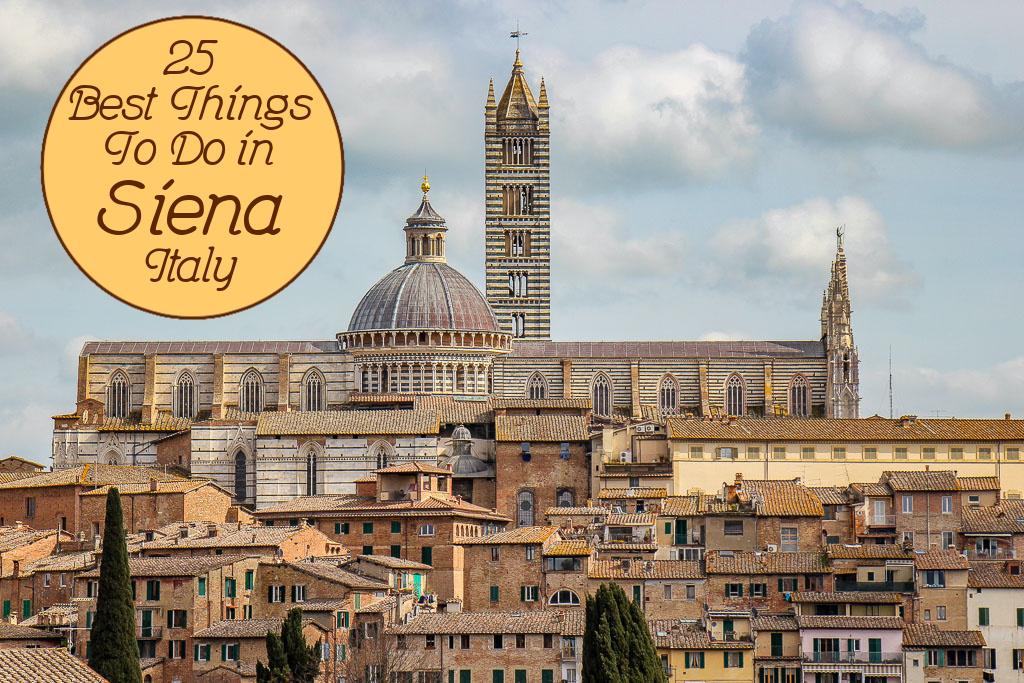
Siena is a quintessential Medieval Italian town with narrow lanes, ornate palaces, vast squares and grandiose churches. You can experience the best of the city with our top things to do in Siena, Italy!
We visited Siena as part of our trip around Tuscany – and were quickly smitten. While a popular day trip destination, those staying longer can truly savor the charm!
Our site utilizes Affiliate Links. If you use them to make a purchase, we may earn a commission. For more information, read our Disclosure Policy.
25 Best Things To Do in Siena, Italy

There are many things to see in Siena, but the city is also a wonder to wander. Our outline of Siena things to do includes it all – plus features a few of the best areas for just aimlessly roaming!
In fact, we organized our list so one sight leads to the next. Therefore, it can be used as a Self-Guided Siena Walking Tour!
#1 Siena City Gates

The historic center of Siena is surrounded by defensive walls – and there are 12 remaining entrances.
Of these, the Camollia Gate is the most impressive – and it is where we recommend you begin your Siena sightseeing.

The monumental gate has a history that stretches back to the year 1082, but the current design dates to 1604.
The decorative entryway gate features three arches and faces the direction of Florence. The inscription above reads, Cor magis tibi sena pandit. This roughly translates to ‘Siena’s heart is open to you’.
#2 Via dei Montanini

Many of the ancient streets within the old town walls are Siena attractions – and Via dei Montanini is one of the most atmospheric.
The elegantly lane is lined with historic buildings and old palaces – some of which are now boutique shops, restaurants and bakeries.
#3 Piazza Salimbeni

The prominent Piazza Salimbeni is a Siena must-see sight. Bordered on three sides by grand palaces, the picturesque square offers an important legacy to Siena’s banking history.
The 14th century, neo–Gothic Palazzo Salimbeni was built as the home of the Salimbeni family. Today it houses the oldest continuously operating bank in the world, Banca Monte dei Paschi di Siena.
Flanking the Salimbeni Palace are two 16th century palaces: Palazzo Spannocchi and Palazzo Cantucci.
In the center of the square is a statue of Sallustio Bandini, who was an 18th century economist, politician and promoter of free trade.
#4 Piazza Tolomei and Church of St. Christopher

Tolomei Square opens on the east side of Via Banchi di Sopra and is marked by a church, a palace and a She-Wolf statue.
The red-brick St. Christopher Church dates to the 11th century and boasts a neoclassical façade with unique brick columns.
Tolomei Palace – one of the oldest in Siena – was built for the wealthy banking family in the 1270s.
The Gothic stone structure is quite imposing when seen from afar and features ornate windows. Pia Tolomei, who lived in Siena in the 1300s, is a character in Dante’s The Divine Comedy.

Standing in the square is an ancient column that is topped with a Capitoline She-Wolf. The sculpture was designed by Sienese artist, Domenico Arrighetti.
#5 Eat a Ricciarelli Almond Pastry
When in Siena, eating a Ricciarelli cookie is a must-do – and Pasticceria Nannini Conca D’Oro is the place to do it!
The famed confection was created in Siena in the 15th century – and Nannini Conca D’Oro has been selling their version since 1910. It can be found in the cases at the back of the shop and pairs well with their renowned coffee.
Another Sienese treat to try is an almond biscotti called Cantucci. The traditional way to eat it is with a glass of the regional Vinsanto wine. It is said to bring out the flavor of the crunchy biscuit!
#6 Loggia della Mercanzia

The Loggia della Mercanzia is an arched portico with lavish pillars. Designed in the early 1400s, the style demonstrates the confluence of Medieval and Renaissance architecture.
It is situated at the intersection of three main throughfares: Banchi di Sopra, Banchi di Sotto and Via di Citta.

The loggia was originally built for the city’s Merchant Guild. However, since the 1700s, it has served as the home of the Circolo degli Uniti – a cultural club for Sienese men.
#7 Piazza del Campo

This is the Medieval city’s main square. The focal point of 11 streets, it is enclosed by the congruent architecture of the Palazzi Signorili, where the town’s wealthiest families resided.
The sloping space has been a gathering place for the public since its inception in the late 1200s. It is also the site of the annual Siena Palio Horse Race.
#8 Palazzo Pubblico

The grandiose Palazzo Pubblico, which is slightly curved to mesh with the circular piazza, serves as the town hall. Construction commenced in 1297.
The striking building features a blend of architectural styles (Gothic and Medieval) and various elements (stone and brick) and is punctuated by the crenellated roofline.
Housed inside is the Museo Civico (Civic Museum). The venue exhibits ancient frescoes as well as other masterpiece paintings.
#9 Torre del Mangia

The most dramatic aspect of Palazzo Pubblico is the towering 335-foot-tall Torre del Mangia. Built in the mid-1300s, it ranked as the tallest structure in Italy when it was completed.
The spire got its name – Tower of Eater – from it’s first bell ringer. The man was nicknamed Mangiaguadagni – as he was known for ‘eating through his earnings.’ The name has stuck ever since!
One of the Siena top things to do is to ascend 400 steps for 360-degree views. The tower climb can also be combined with visiting the Museo Civico for a discounted price.
#10 Cappella di Piazza

This white marble tabernacle sits at the base of the Torre del Mangia and is the only structure to disrupt the circular line of the piazza.
Built in 1352 and dedicated to the Virgin Mary, the adorned chapel was an offering of thanks for sparing those who survived the 1348 Black Plague.
#11 Fonte Gaia

When water was piped into Piazza del Campo in the 1340s, this then simple fountain was named Fonte Gaia – or Joyous Fountain.
In 1419, it was embellished with carved marble panels. They tell stories from the bible and the wolf spouting water is the She-Wolf mother of Remus and Romulus.
The pieces did not fare well and what you see today are replicas commissioned in 1859. The originals are on display at the Museum of Santa Maria della Scala, which we feature later.
#12 Lunch on Piazza del Campo

We recommend picking up takeaway at Te Ke Voi? and finding a place to sit in the square to enjoy your meal. The shop is located right next to the Loggia and they make quick and delicious focaccia sandwiches.
#13 Contrade of Siena

During Medieval times, the old city of Siena was segmented into contrade – or districts – for both military and clerical purposes. They became tight-knit communities and often developed a specific trade.
Although only 17 of the original 59 contrade exist today, each one still operates as a tribe, with a symbol, flag, museum, church, fountain and motto.

The Palio Horse Race is a competition between the Siena contrade – and the winner earns bragging rights for the entire year.
One of the unusual things to do in Siena is to seek out the different districts based on the contrade symbols. Look for plaques by street names, sculpted animals and the colorful flags.
#14 Palazzo Chigi-Saracini

This Gothic palace dates to the 12th century and follows the crescent curve of Via di Citta. For centuries it served as a residence, but in 1965 the building was left to the Siena Chigiana Music Academy.
Concerts are still held inside and visitors can join guided tours of the interior. However, the quaint courtyard within the palace is open for free and it’s one of the hidden things to see in Siena.
#15 Piazza del Duomo and Siena Cathedral

Fascinating both inside and out, the cathedral in Siena is a sight to behold (even though part of it was never completed) and it’s filled with fabulous treasures.
The façade is intricately carved, while the rather unadorned bell tower is striped with black and white marble (a nod to Siena’s town colors).

The interior is decorated with an abundance of bewildering artwork, leaving you wondering which way to look.
The distinctive white-and-black striped pattern extends to the giant columns along the nave – and heads of former bishops peer down at parishioners.
Even the floor features artwork in the form of colorful, etched marble slabs (the Massacre of the Innocents paints a vivid scene).

Other artwork not to be missed is the statue of St. John the Baptist by Donatello, the statue of St. Paul by Michelangelo that stands in the Piccolomini Altar and the carved marble pulpit by Nicola Pisano.
#16 Piccolomini Library

Located inside the cathedral (and included with admission), the Piccolomini Library is one of the best Siena sights to see.
The small library room houses a collection of ancient choir books. Their large size ensured the songs could be seen by all the singers.
Even more impressive are the detailed and vivid frescoes that bedeck the walls and tell the story of Siena born Enea Silvio Piccolomini – better known as Pope Pius II.
#17 Cathedral Museum, Baptistry and Crypt
The Museo dell’Opera, Baptistry of San Giovanni, and subterranean Crypt are a few more places to see within the duomo complex.
The Museum Cathedral, which was founded in 1869, hosts a collection of fine artwork, tapestries, jewelry and manuscripts.
The Baptistry is festooned in Renaissance frescoes, yet the magnificent marble Baptismal Font is the centerpiece. In the crypt, there’s 13th century frescoes that were only discovered in 1999.
#18 Unfinished Cathedral Façade

The Siena Cathedral was completed in the late 1200s. However, by 1339 there were already plans to double its size. The competition with Florence was fierce and Siena wanted a bigger church.
A grand plan was designed and building commenced. Then, in 1348 the Black Plague struck, nearly cutting the population in half.
The city never fully recovered – and many survivors believed that their competitive attitude was what brought the plague upon them.
Therefore, the Facciatone di Duomo – the New Cathedral Façade – was left in an unfinished state. Today, the incomplete façade is where to go in Siena for phenomenal views!
#19 Santa Maria della Scala
One of the oldest hospitals in Europe, Santa Maria della Scala opened in 1090 (but possibly has origins to 898).
It was dedicated to feeding the poor, caring for orphans and housing pilgrims on the Via Francigena route from Rome to Canterbury, England.
Throughout the centuries, the hospital amassed a collection of masterpiece artworks and artists were commissioned to paint frescoes on the walls.
In 1995, it was converted into a museum showcasing its historical, archaeological and religious artifacts. The Museo Archeologico Nazionale is part of the Santa Maria della Scala complex.
#20 Via del Costone Pedestrian Path
The Via del Costone walkway is somewhat of a hidden gem. Along the downhill route, you’re greeted with fabulous views and the hulking Basilica Cateriniana San Domenico looms large is the distance.
Via del Costone was often used by a young Saint Catherine. It’s said, when she was walking along the path, she had her first spiritual vision of Jesus.
#21 Fontebranda Medieval Fountain

Located in the Contrada dell’Oca (the Goose neighborhood), the ancient Fontebranda is the city’s most beautiful fountain.
Built in 1246 by the Wool Makers Guild, the brick structure covers a pool of water that is brought in via aqueducts from a natural source 15 miles away.
There are three Gothic arched entrances and originally, three basins into which the water was distributed. Historically, each entryway was dedicated for a specific purpose.
The first was drinking water for people, the second provided water for animals and the last was for washing clothes. Fontebranda is also mentioned by Dante in The Inferno.
#22 Santuario Casa di Santa Caterina
The Shrine to St. Catherine is not a church, but rather the home where she grew up and lived. The cheerful yellow complex features a long, arched portico.
The chapels within the home were created after her death and the shrine is meant to be a place of quiet contemplation. It is free to enter the complex and visit the rooms and chapel.
#23 Basilica Cateriniana San Domenico

There are many, many churches in Siena, Italy – but none quite as intriguing as the Basilica of San Domenico. It dates to 1226, but was renovated in the Gothic style in the 14th century.
The large brick structure is dedicated to St. Catherine. While the vast interior feels a bit cavernous, the site hosts the her head and finger!
#24 Fortezza Medicea

The massive Medicea Fort was built in the 1560s as a defensive measure. It was used for military functions until the late 1700s.
In 1937, it was restored and reopened as a public park. Inside, there are walking paths, fountains, a theater and a bar. The tops of the thick, brick walls have been repurposed into grassy parks.
#25 Vista Panoramica di Siena

One of the top things to see in Siena is the city from afar – and this is the prime spot! In addition to the terrace providing a phenomenal viewpoint, it also hosts artistic sculptures and a pleasant café and bistro!

More Things To Do in Siena, Tuscany

We have shared our prime picks for the best things to see in Siena, Italy. However, there are a few more sights that fellow travelers might be interested in seeking out.
Via della Galluzza
The sloping Via della Galluzza provides another dramatic entrance to Siena. Walking beneath the series of picturesque arches leads up to Via Diacetto and Piazza di Indipendenza.
Piazza di Indipendenza
Only designed in the late 1800s, the centerpiece of the square is a yellow, three-arched loggia. The prestigious Teatro dei Rozzi theater is also located here.
Botanic Garden
The shaded Orto Botanico dell’Universita is nice escape on hot days. It was established in 1588 and the collection of plants (located on the grounds and in greenhouses) are clearly labeled.
Pinacoteca Nazionale
Founded in 1932, the National Art Gallery of Siena houses fine Italian Renaissance art. It features a large collection of paintings from Sienese artists dating from the 14th and 15th centuries.
Wineries in Siena
Situated in one of the most renowned wine making regions in the world, sampling local wine is one of the top things to do in Siena, Tuscany.
The best way to experience Tuscan wine is to join a tour. This 3-hour excursion features a tasting and includes exploring the vineyards, seeing the cellar and trying regional foods, too!
Alternatively, join a full day tour to one of the top wineries near Siena. This small-group expedition includes touring the facilities, tasting the wine, eating a local lunch and discovering a Tuscan village.
Cooking Class in Siena
Learn the art of Tuscan food by joining this highly rated class, which is led by a professional chef. Participants learn how to make a few regional specialties and then try out their creations.
Guided Walking Tour of Siena
We’ve highlighted the Siena must-see attractions and listed them in order for a self-guided walk. Those who would rather let a guide lead the way should join a top-rated tour, like this one!
Tour Places Near Siena
Travelers staying in Siena might consider taking a day trip to explore more of the region. This organized full-day tour includes Pienza and Montalcino!
Where To Eat in Siena, Italy

Eating in Siena is just as important as sightseeing! Tuscan cuisine is delectable – and you should certainly get a taste of the regional specialties.
Want to combine Siena sightseeing with eating? Join a local guide for a Walking Food Tour!
Antica Trattoria Papei
Hailed by many as the best restaurant in Siena – Antica Trattoria Papei is known for their pasta dishes. Order the pici!
Osteria Permalico
Regularly rated as one of the best restaurants Siena, Italy, Osteria Permalico specializes in Tuscan cuisine. It’s a good place to try the Cinta Senese cured meat.
Pretto Prosciutteria e Convivio
Offering typical Tuscan meats, cheeses and sandwiches, Pretto Prosciutteria e Convivio is a favorite spot for a ‘Cutting Board’ meal. They also get rave reviews for their Lampredotto sandwich – a Tuscan specialty!
La Vecchia Latteria
A top pick for the best gelato in Siena, Italy – especially their fruit flavors that feature real pieces of fruit!
Tourist Map of Siena, Italy
Use this Google Map for an interactive version of our Siena map below.

Planning a Trip to Siena, Italy

In addition to our advice for sightseeing in Siena, we’re discussing when to go, where to stay and what to pack.
Those planning to visit Siena from abroad will find our Tips for Planning a Europe Vacation to be useful, as well.
Traveling to other parts of Tuscany and Italy? You can use all our Italy Travel Guides to plan your best trip!
- One Week in Tuscany Itinerary
- The Best 3 Days in Florence
- How To Spend 3 Days in Rome
- What To See in Pisa
- Things To Do in San Gimignano
- A Day in Lucca
- Discover Lecce, Italy
- Venice in a Day
- Our Free Milan Walking Tour
- Things To See in Bergamo
As you plan your travel to Siena, organization is key. We recommend using our Printable Travel Planner to keep track of all the details of your vacation!

Best Time to Visit Siena, Italy

Although the summer is the most popular time to take a Siena vacation, we don’t recommend it. Not only is the town crushed with other tourists, but the weather can be stifling hot.
Fall can be a fabulous time to go to Siena. The temperatures begin to cool and autumn marks harvest season.
Winters can be cold, but we imagine spending Christmas in Siena would be magical. It could also fit in nicely with some of the other Best Christmas Places in Europe!
Still, we believe spring is the best time to go to Siena. The weather is warm, but not hot. Plus, there are fewer crowds and lower prices!
How To Get to Siena
Without a car, Siena can be reached by bus, train or private driver. The closest airport to Siena is in Florence (FLR). Other airports in the region are Perugia, Pisa, Bologna and Rome.
The distance between Florence and Siena is 55 miles and the two are well-connected. The close proximity and options for transit make it rather easy to plan a day trip from Florence to Siena.
Riding the train to Siena from Florence takes about 1.5 hours. You will arrive at the Siena FS Train Station that is about a 10-minute walk from Porta Camollia (with the help of an escalator).
From Florence, the fastest bus to Siena takes about 1 hour and 20 minutes. The bus station (basically a bunch of bus stops) is at Piazza Antonio Gramsci. You can opt to exit at the Porta Camollia, and enjoy a pleasant walk into town like we did!
Travelers can also join one of the popular bus tours to Siena from Florence that include multiple destinations – like this highly rated excursion.
Where To Stay in Siena, Italy
We were only in Siena for a day, so we didn’t need a hotel. But for a future trip, we’ve rounded up a few hotels where we would stay in a heartbeat!
Quite possibly the best hotel in Siena, Palazzetto Rosso is located right in the middle of the old town. The property features rooms with views and comfortable beds – plus they offer breakfast.
Hotel Duomo is a more affordable option, but it still has heaps of charm! Occupying a 12th century mansion, the historic hotel features bits of the past, as well as modern conveniences.
Interested in sleeping in a castle in Siena? While Hotel Palazzo di Valli is not in the center, it occupies an 18th century villa and is surrounded by a lush garden!
What To Pack for Siena

Whether traveling to Siena for a day or a week, there are a few things you will want to pack in your suitcase. Go ahead and grab our FREE Checklist and let’s get you to Italy!
Comfortable Shoes
The best Siena places to visit will require a fair bit of walking. I like to wear versatile trainers and Kris is most comfortable in trail shoes. You can find specific tips and reviews in our Guide to the Best Shoes for Travel.
Travel Camera
The Siena places to see are stunningly beautiful! Rather than using your phone, we recommend upgrading to a real camera. We use a DSLR Canon Rebel with a 18-135mm lens.
Appropriate Clothing and Sun Protection
Churches are top Siena places to visit – and you will want to make sure you are dressed appropriately. We recommend bringing a lightweight wrap to cover shoulders or knees.
Also, bear in mind that the Tuscan sun is strong! It is best to bring sunscreen, as it’s quite expensive locally. Don’t forget a wide-brimmed travel hat and your favorite pair of sunglasses, too!
Day Pack
Those spending a full day exploring will want to carry a proper pack. For our Siena trip, we used these small backpacks. You can read our Reviews for the Best Day Bags for different styles and options.
European Travel Insurance
Trip insurance can cover a range of unexpected costs – from flight cancellations to lost luggage to getting sick abroad. If you haven’t already obtained coverage, check the rates at World Nomads.
Start planning your trip to Italy! Search for the lowest airfares, the best accommodations and fun things to do…then start packing! Want additional advice? Head over to our Travel Planning Page and for country-specific information, take a look at our Travel Guides Page!
More Top European Destinations
- 3 Day Amsterdam Itinerary
- 1 Week in London
- How To Plan a Trip to Croatia
- One Week in Spain Itinerary
- 7 Days in Ireland Vacation
- Best Itineraries for Paris
- 2 Weeks in Greece
- 10 Days in Scotland

Pin it! See all of our travel pins on our JetSetting Fools Pinterest Board.
