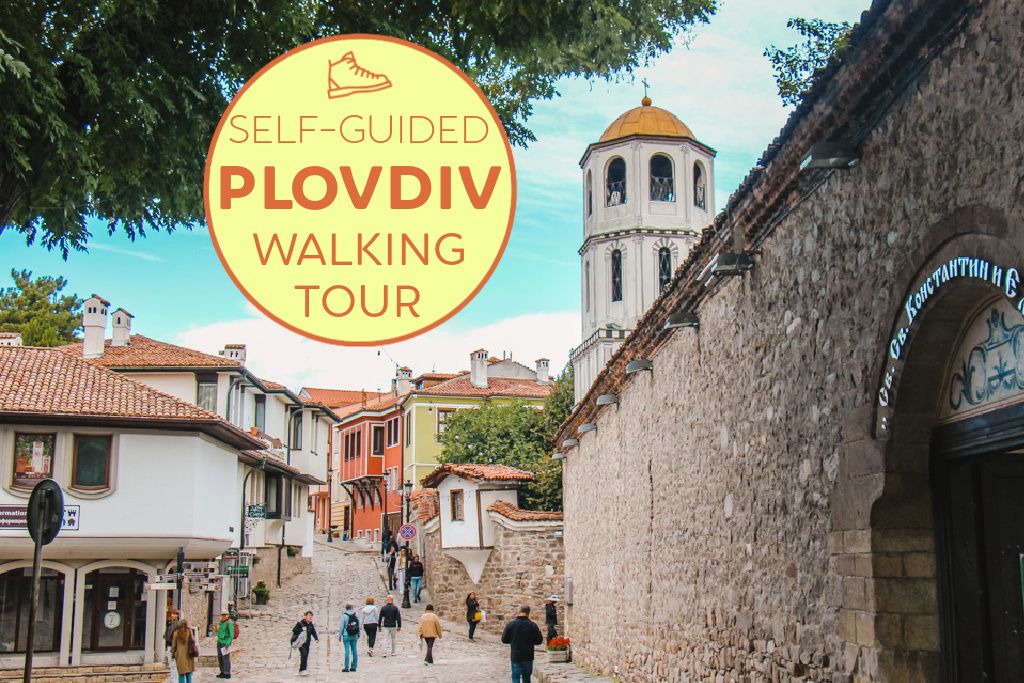
Plovdiv, Bulgaria beckons to be explored. Ancient ruins. Gorgeous architecture. Beautiful churches. Colorful corners. Lofty perches.
The only problem is that, with its twisting lanes and hilly landscapes, it’s easy to accidently skip some major sights.
Our site utilizes Affiliate Links. If you use them to make a purchase, we may earn a commission. For more information, read our Disclosure Policy.
So, we created this Self-Guided Plovdiv Walking Tour that winds through the center of town – and ensures that you don’t miss a thing!
Self-Guided Plovdiv Tour Details
Our outlined walk in Plovdiv is about 2.5 miles. It took us approximately 2 hours to complete – which included time for taking photos, reading information plaques and eating gelato.
The tour fits perfectly into our Plovdiv Itinerary; check it out if you are looking for more things to do!
For walking directions, we provide map links for each attraction, as well as an overview at the end of this article.
For easy navigation, you will need a wireless connection. We recommend using an eSim or Pocket WiFi – and don’t forget your portable charger for a boost!
Durable travel shoes are essential, as the sidewalks in Plovdiv are sloped and uneven. We also suggest having a day bag. We use these small backpacks to tote our extra layers, travel umbrella and water bottles.
Prefer this walk in PDF format without the ads? You can buy one for less than a coffee! Looking to meet fellow travelers, instead? Consider joining this highly-rated tour!
History of Plovdiv, Bulgaria
This city is layered in yesteryear, literally! In order to make sense of the sights on our Plovdiv walk, it’s best to understand a bit about its past.
Plovdiv can trace its origins to around 7,000 BC, making it one of the oldest continuously inhabited cities in Europe.
The ancient Thracian town was conquered in 342 BC by Phillip II of Macedon (father of Alexander the Great). He renamed it Philippopolis (after himself).
Philippopolis became part of the Roman Empire in the 1st century BC. They changed the name to Trimontium (City of Three Hills) – and for thousands of years, it thrived.
In the Middle Ages, the city was burnt to the ground, rebuilt, and incorporated into the First Bulgarian Empire.
Then, it was raided by numerous rulers – including the Byzantines, the Huns and the Latin Empire. During this time, Philippopolis became known as Pulpudeva, Puldin and Plovdin.
In 1371, it fell to the Ottomans – and again renamed, this time to Filibe. They ruled here until the 1878 Battle of Plovdiv, one of the final conflicts of the Russo-Turkish War.
Plovdiv then became the capital of Eastern Rumelia – and was finally reunited with Bulgaria in 1885.
Throughout the 20th century, Plovdiv grew to become Bulgaria’s 2nd-largest industrial, cultural and economic city. It was significantly expanded – and reshaped – by the Soviet regime from 1944 to 1989.
20 years after the fall of communism, Plovdiv was named the European Capital of Culture in 2019. With that came an artistic revival, with regeneration of historic districts and a vibrant creative scene.
Plovdiv Walking Tour: Self-Guided

Now that you’ve digested that rundown of events, it’s time to lace up your shoes so we can get started. Historic Plovdiv may be small, but there is a lot to see!
#1 Roman Forum of Philippopolis

MAP. There’s no better place to start a walking tour in Plovdiv than at the historical center. Here, you can see a clear juxtaposition of old and new, past and present.
The unearthed Philippopolis Forum is situated right next to the Soviet-style Brutalist Central Post Office. In fact, the ruins were discovered when building it in 1971.
In Roman times, this area served as a commercial, administrative and religious hub. Excavations have revealed the Odeon (Ancient Council Hall), Library and Treasury – as well as statues, temples and shops.

The Forum marks the spot where the city’s two main streets – Cardo Maximus and Decumanus Maximus – intersected. It’s where announcements were made, speeches were delivered and celebrations took place.
Today, the remains are an open-air public space – and visitors are free to get an up-close view of the pedestals, fragments and remnants of history.
#2 Tsar Simeon Garden Park

MAP. The next stop on your walking tour of Plovdiv is the city’s most famous green space: Tsar Simeon Park.
Established in 1892 for the First Bulgarian Agricultural and Industrial Exhibition, it is a favorite local spot for outdoor fun and relaxation.
It’s ideal for leisurely walks under the century-old shade trees, but while wandering, don’t miss the Singing Fountains!

During the day, the waterspouts flow in streams – but on summer weekend nights, the water synchronizes with light and music to put on an entertaining show.
Two other sights here that are worth seeking out are the Viennese Pavilion (a replica) and the Goddess Demeter Fountain (an 1892 original).
Top Tip: Before continuing on your self-guided tour, grab a gelato at Ice Cream House Afreddo – map. It makes the stroll a little bit sweeter!
#3 Walking Street: Knyza Alexander I Battenberg

MAP. Nicknamed Glavnata – or The Main – this pedestrianized thoroughfare weaves right through the center of town…just as it has since the Ottoman era.
In those days, it was a narrow trade bazaar with nearly 900 small shops…and barely enough room for carts to squeeze through.
Much wider now, it is still lined with shops – with international brands alongside local boutiques, pharmacies, grocery stores, cafes and restaurants.
Most of the architecture dates to the 20th century, but there are a few gems along the way, which are the next stops on the tour!
#4 Plovdiv City Hall

MAP. Situated on Stefan Stambolov Square, the stately structure serves as the civic heart of the modern city.
Completed in 1914, the building is highly regarded for its second-floor balcony and ornate meeting hall – as well as the leafy garden and fountain that sit out front.
#5 Statue of Milyo

MAP. Not your run-of-the-mill effigy, Milyo invites you to whisper wishes in his ear…and if you rub his knee, he’ll make them come true.
While that is, of course, just a fun local legend, the statue depicts a real-life person – known locally as Milyo the Mad – who often sat on these very stones.
Born in the 1920s, Milyo was destitute but exuded an eccentric charm and always wore his signature cap. Beloved by Plovdiv’s artistic community, this monument was erected in his honor in 2005.
#6 H&M Department Store

MAP. Next, head inside H&M – not to shop, but to see history! During renovations in 2006, part of the eastern sector of the 2nd century Roman stadium was uncovered here.
Rather than evicting the store or concealing the ruins, an agreement was made to open the archaeological remains to the public.
Although a ticket is required to enter the space, you can still get a good glimpse of it for free from the sales floor. (And you will see much more of it on the next stop on the tour!)
#7 Ancient Stadium of Philippopolis

MAP. While most of the Roman Stadium is buried beneath the city (the outline is marked on the pavement of the pedestrian street), the curved northern section, called the Sphendone, has been meticulously restored.
Discovered in 1923, the marble-and-brick arena sits just below street level…and it’s absolutely free to take the stairs down to explore it.
Take a seat and envision the stadium stretching out before you. In Roman times, the oblong amphitheater (820×160 feet) hosted organized games and sporting events. It could hold an astounding 30,000 spectators!
It’s one of the best-preserved Roman ruins in the Balkans – and now stands as a Plovdiv landmark.
#8 Djumaya Mosque

MAP. A fantastic example of Plovdiv’s multicultural history, the Djumaya – or Friday – Mosque stands just steps from the Philippopolis Stadium.
Featuring 9 lead-covered domes and a slender minaret, the still-active site dates to the 15th century. The design incorporates Ottoman, Byzantine and traditional Bulgarian masonry styles.

Inside, the walls feature 19th century floral paintings and gigantic chandeliers hang from the ceiling. There is also a bookshop and café serving traditional Turkish coffee and sweets.
It’s free to visit outside of prayer times; appropriate attire (including head coverings for women) is required and shoes must be removed.
#9 Church of the Holy Mother of God

MAP. A grandiose, 3-nave church with a distinctive bell tower, The Holy Mother of God is a point of pride for Plovdiv.
Built in the 19th century, it stands on the site of previous Christian churches (dating back to the 9th century).
On Christmas Day in 1859, the service was spoken in the Bulgarian language for the very first time. It ignited the movement to split from the Greek Patriarchate and become an independent Bulgarian Orthodox Church.
The interior is richly decorated with gilded woodcarvings and icons – so it’s worth popping inside to take a look.
Before leaving the grounds, stop by the adjacent Orthodox Church St. Nicholas – map. Inside the small chapel is an iconostasis that dates to 1733 (the oldest in the city) with detailed carvings.
#10 Ancient Theater of Philippopolis

MAP. Only discovered in the 1970s after a major landslide, the Roman Theater of Philippopolis is a dazzling sight.
Built in the 1st century in the saddle between two of Plovdiv’s hills, it had room for 7,000 spectators.
Preserved features include 28 tiers of white marble seats, a horseshoe-shaped orchestra and Corinthian columns.
What truly makes it unique, however, is that it still functions as an open-air stage, hosting musical performances and festivals.
A ticket is required to go inside, but you can see the entirety of the theater through the fence; the views from the far left side are the best!
#11 Old Town Plovdiv: Saborna Street

MAP. The Plovdiv Old Town is one of the most atmospheric districts in the city. The main pedestrian street, Saborna, is lined with colorful merchant homes from the Ottoman era.
Today, those houses are occupied by interesting historical museums, artist galleries and vintage stores.
We highly recommend stepping inside the antique shops to see the items for sale; the owners helpfully explain the history of the objects.
As you walk along, note that many buildings feature upper levels that extend over the lower floors. This intriguing design was not aesthetic; it was a way to save on property taxes during Ottoman rule.
At that time, taxes were calculated based on the ground-level footprint, so extending the upper floors outwards added to the size of the home without increasing costs!
#12 St. Constantine and Helena Church

MAP. Considered to be the oldest church in Plovdiv, St. Constantine and Helena can trace its origins to the year 337 AD.
It was built in the exact place where martyrs were beheaded under the religious persecutions of Emperor Diocletian.
After Constantine the Great legalized Christianity in 311, it was constructed and named after him and his mother, Saint Helena.
During the Ottoman period, the church was reduced to a humble wooden structure to comply with the strict religious laws.
Then, during the Bulgarian National Revival in 1832, it was completely renovated and expanded into the church that stands today. Inside, you will find an exquisitely carved iconostasis, along with precious icons and murals.
#13 Hisar Kapia Gate

MAP. Walls have long encircled Plovdiv as a prime means of defense, with evidence of fortifications being present as early as the 4th century BC.
Hisar Kapia – or Castle Gate – however, was built during the Middle Ages (on top of foundations of a 2nd century Roman gate). The entryway was one of three to the ancient Plovdiv acropolis.
These defenses became less important following the Ottoman invasion. During the 17th and 18th centuries, when rich merchants were building mansions, they integrated the remaining wall into their abodes.
#14 Dimitar Georgiadi House (Historical Museum)

MAP. This striking red structure is a classic Plovdiv saray (mansion). It was commissioned by a wealthy tailor in 1848 as a dowry gift to his daughter and new husband, Greek merchant Dimitar Georgiadi.
The house is a masterpiece of 19th century Revival architecture, featuring wood-carved ceilings, decorative niches and beautiful murals.
Now occupied by the Regional History Museum, exhibits detail the period from the 15th to 19th centuries. (Tickets are required.)
#15 Street of Crafts (Stramna St)

MAP. Translating to Steep Street, Stramna is a narrow, twisting cobblestone alley characterized by its 19th century National Revival houses. But it’s so much more than a pretty place to walk!
Masters of traditional Bulgarian trades – like weaving, carving and knife-making – have opened studios here to practice their trade.
Visitors are welcome to watch the artists at work. We feel it’s a fabulous place to pick up authentic souvenirs – and some traders host hands-on workshops, as well.
#16 Church of St. Nedelya

MAP. A large and spacious Orthodox church, St. Nedelya was completed in 1831. It’s highly praised for the classic stone-and-wood craftmanship – but don’t skip going inside.
The massive wooden iconostasis is a remarkable (be sure to get an up-close look) and colorful painted murals decorate the walls. (It’s free to enter.)
#17 House of Nedkovich

MAP. Built for a wealthy textile merchant in 1863, Nedkovich House features a blend of architectural styles, notably European Classicism.
The columned portico and richly decorated façade are distinctive – as is the interior, which features actual furniture from the family’s estate. (A ticket is required to enter, but it’s free to go inside the courtyard.)
#18 Regional Ethnographic Museum

MAP. A masterpiece of Bulgarian National Revival architecture, the Kuyumdzhioglu House was built in the mid-19th century for a local textile merchant.
The exquisite façade features the elegant curves and balanced symmetry of the Balkan Baroque style.
The property was transformed into the Regional Ethnographic Museum in 1943 – but it has also served as a boarding school for girls, a hat factory, a flour warehouse and a vinegar factory.
There are more than 40,000 artifacts within it’s collection and many rooms recreate the wealthy 19th century merchants’ life. (Ticket required, but the garden is free.)
#19 Bakalova Craft House (and Rahat Tepe Restaurant)

MAP. An authentic dwelling, Bakalova House has been restored into the Craft Center. Also called the House of Tradition, the rooms showcase traditional works (much like the homes on Street of Crafts).
We were mesmerized by the woman using an old wooden loom to create a stunning scarf. She happily explained the process as we looked on and her items are available at fair prices.
Directly across the lane is Rahat Tepe. We feared it was a tourist trap, but the eatery serves traditional, homecooked meals, brews it’s own beer and offers an exceptional view.
#20 Nebet Tepe

MAP. Considered the ‘Birthplace of Plovdiv’, this site contains evidence of six-thousand years of history – from Thracian settlement to the Ottomans.
Occupying the northernmost peak in Old Plovdiv, Nebet Tepe translates to Guard Hill – aptly named, as remains of ancient fortress walls and towers have been revealed.
Today, the Archaeological Complex of Nebet Tepe is open to the public for free. See the Cyclopean stone walls (built without mortar), remnants of Roman fortifications, a medieval water reservoir and a secret tunnel that once led to the riverbank.
The relics are fascinating, but the view is spectacular. The 360-degree vista over Plovdiv rooftops and the distant mountains is simply sublime – and our favorite spot for sunset!
#21 Kapana

MAP. The final stop on our Plovdiv self-guided tour is the humming Kapana district. First established in the 16th century as a hub of workshops, the artisan quarter encompasses multiple cozy lanes.
Today, The Trap (which is what the Bulgarian word Kapana translates to) is the perfect place to get lost for a bit.
The enclave is jam-packed with bars, cafes, restaurants – and a few art galleries and modern craft shops, as well as some street murals. Wander around for a bit, then give your feet a much-deserved rest.
For local craft beer, go to Cat and Mouse Beer Bar – map. If you need some sustenance, take a seat at Aylyakria – map. Just want a coffee? Dukiana Craftex Roastery is the place to go – map.

Map of Plovdiv Walking Tour
Use this online map for an interactive version of our Plovdiv Map below.

Additional Things To Do in Plovdiv

That wraps up our Self-Guided Walking Tour of Plovdiv – but we have a few suggestions of what to do next!
More Roman Ruins
If you are as fascinated by these remnants as we are, there are a few more places you will want to see – like the Ancient Eastern Gate of Philippopolis and the Roman Aqueduct.
Museums and Historic Houses

There are tons of museums in Plovdiv (Pharmacy Museum Hippocrates, Zlatyu Boyadzhiev Exhibit, Small Basilica, Bishop’s Basilica, to name a few) and mansions that are open for tours (like Lamartine House, Hindliyan’s House and Balabanov’s House).
Admission to most cultural sites is usually just a few euros, but you can also purchase a combined ticket for a bargain price. See what’s included here.
Churches
We featured a few places of worship on our walking tour, but there are several we didn’t visit.
Sveta Marina, Sveta Prepodobna Petka, the Temple of St. George, and the Catholic Cathedral of St. Louis are worth seeing, as well.
More Hills in Plovdiv

Plovdiv has long been called the City of Seven Hills. In addition to the three that make up the historic town (Nebet Tepe, Taxim Tepe and Dzhambaz Tepe), there are three more nearby to climb.
(In case you’re wondering about the math, the seventh hill no longer stands, as it was quarried for paving stones!)
Danov Hill (Sahat Tepe) is right in the city center. It’s just a short trek up to the cute Clock Tower and a not-so-cute communication cluster.
To the west is Bunardzhik Hill, which is famous (or infamous) for its Monument to the Red Army Alyosha.
Youth Hill stands to the southwest; it’s the highest and provides sweeping views of the entire region on clear days.
Start planning your trip to Bulgaria! Search for the lowest airfares, the best accommodations and fun things to do…then start packing! Want additional advice? Head over to our Travel Planning Page and for country-specific information, take a look at our Travel Guides Page!
Nearby Destinations
- The Best of Sofia in One Day
- Fun Self-Guided Sofia Walk
- One Week in Romania
- 2 Weeks in Greece
- Things To Do in Skopje

Pin it! See all of our travel pins on our JetSetting Fools Pinterest Board.
