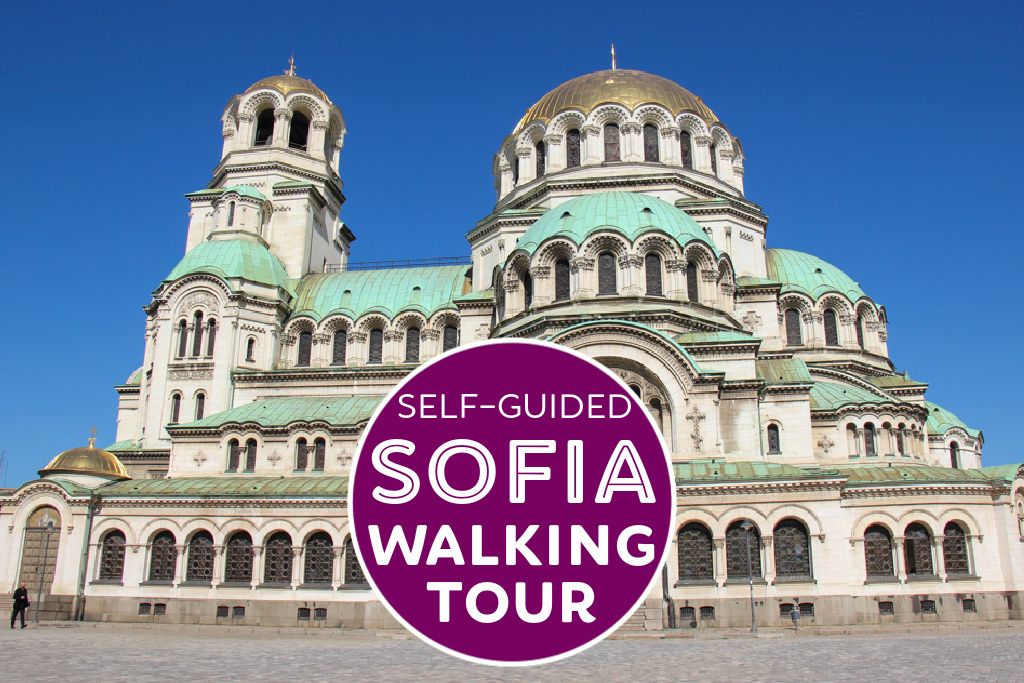
We had so much fun exploring Sofia, Bulgaria on foot! The capital’s historic center is compact – but despite its size, there is so much to see.
From magnificent churches to ancient ruins to sublime outdoor spaces, this Free, Self-Guided Sofia Walking Tour covers the prime attractions along with a few hidden gems.
Our site utilizes Affiliate Links. If you use them to make a purchase, we may earn a commission. For more information, read our Disclosure Policy.
We used this route for our first trip to Sofia – and believe it’s the best way to get acquainted with the city!
Free Sofia Walking Tour Details
Our outlined tour is about 2 miles long. It took us roughly 3 hours to complete – which included quick stops for street food, taking photos and entering churches.
We designed this walk of Sofia, Bulgaria to showcase the best of the city – but there is more to see! Use our One Day Sofia Itinerary to plan your full-day adventure.
We’ve provided map links for walking directions to each stop on the tour – as well as an overview later in the article.
This free tour is designed to allow you to explore at your own pace. That said, there are plenty of inexpensive tours led by local guides – like this highly rated one.
What You Will Need
In order to access the directions, make sure you have a reliable connection. You can use an eSim, Pocket WiFi Device or upgrade to an international plan.
For your walk, you want to wear a durable travel shoes (there is some uneven pavement); I wore my everyday trainers.
We also recommend having a versatile day pack that can securely hold your everyday travel items – as well as an extra layer, travel umbrella and camera.
Would you prefer a PDF version of our walk without the ads? You can purchase one for about the price of a coffee!
Our Self-Guided Sofia Walking Tour

Okay, there is actually quite a lot to take in, so lace up your shoes and let’s get going!
#1 Serdica Forum: Roman Ruins

MAP. Begin your walking tour of Sofia, Bulgaria right in the heart of the ancient Roman city of Serdica (also spelled Serdika).
Established as a settlement of the Serdi tribe, this area became an official city under the Roman Republic in the 1st century AD.
Serdica evolved into a regional hub, then a capital – and was even said to be a favorite place of Emperor Constantine the Great.
In the 4th century, Christianity was legalized by Roman Emperor Galerius. Then, just 100 years later, the city was destroyed by the Huns. It was later rebuilt by the Byzantines under Emperor Justinian I.
In 809, the First Bulgarian Empire captured Serdica and renamed it Sredets. The name changed again, this time to Sofia, in 1376 – but then it fell to the Ottoman Empire in 1382.
Throughout the centuries, the city has endured invasions and natural disasters – with each consequential rebuild burying structures, streets and basilicas.
Ruins have been excavated since the 1950s – but it was only in the 2010s, during the construction of the Serdika II Metro Station, that the former Roman Cardo Maximus (north-south) street was discovered.
Today, this section runs alongside Knyagina Maria Luisa Blvd as an open-air museum and is free to explore.
#2 Banya Bashi Mosque

MAP. Just a few steps to the north is the second stop on our Sofia tour: the striking Banya Bashi Mosque.
Built by the Ottomans in the 1560s, the stone-and-brick structure features a large central dome (approximately 50 feet in diameter) and a slender minaret.
It was purposely constructed at the site of natural thermal mineral springs – and its name translates to ‘Head of the Bath’.
During Ottoman rule, Sofia was home to more than 50 mosques. However, after the Russo-Turkish War in 1877-1878, most were destroyed or repurposed.
Today, Banya Bashi is the only functioning mosque in Sofia. It’s open to the public outside of prayer times, but proper dress is required.
The mosque occupies one corner of the ‘Square of Religious Tolerance’ – as nearby there is also a synagogue, a Catholic church and an Orthodox church…and we’ll get to them all on this walk!
#3 Central Mineral Baths (Regional History Museum of Sofia)

MAP. Standing as a Sofia landmark, the Central Mineral Bath House is magnificent – but the history of the springs go back to Roman times and the natural waters are still an integral part of the city.
The first public baths – an Ottoman hammam – were built here in the mid-1500s, but the current yellow-and-white striped building dates to the in the early 1900s.
The grandiose building was designed in the Vienna Secession style, but Byzantine and traditional Bulgarian elements are also present.
The municipal baths operated until 1986, when the building fell into disrepair. In 2015, it was renovated and reopened as the Sofia History Museum. (Ticket required.)
The surrounding park and plaza, which features a pretty fountain, are popular places for locals to congregate.
On the north side of the square, mineral water flows freely from taps – and anyone can come and fill up their bottles!
#4 Central Market Hall of Sofia

MAP. Next on our list of places to see is the Sofia Central Market. Although the building is now mostly occupied by a grocery store, the interior is absolutely beautiful and still holds historic significance.
Built in the early 1900s in place of an older wooden bazaar, the massive 35,000 square foot marketplace once housed more than 170 stalls selling meat, dairy, fish and produce.
The exterior is embellished with the intricate Sofia coat of arms and a squat bell tower.
We feel it’s worth popping inside to see the enormity of the space. Look up at the steel roof truss system and then take the escalator down to the basement.
There you will find more Roman ruins, along with informational plaques that provide additional details about ancient Serdika.
#5 Central Synagogue of Sofia

MAP. The Sofia Synagogue provides more evidence of the area’s diverse heritage and fascinating history.
Although the number of Jews living in Sofia today is rather small, the city has been home to a Jewish community since at least the 8th century.
This synagogue was built in the early 1900s – and it stands as one of the largest Sephardic (Spanish Jewish) synagogues in Europe.
There are an astounding 1,170 seats and the interior is decorated with a chandelier, mosaics, columns and carvings. It is an active place of worship, but visitors are welcome with paid entry.
DETOUR: Sofia Women’s Market

MAP. A little bit out of the way, this is the oldest market in Sofia. The colorful Zhenski Pazar was established in 1878, just before Bulgaria’s liberation from Ottoman rule.
There are different stories as to how the space earned its name. Some say it’s from an Ottoman tradition of only allowing women to shop on certain days. Another version is that it was typically women from the countryside who sold goods here.
Either way, in modern times, all genders are permitted as vendors and we found it fun to walk around to see what produce was currently in season.
#6 St. Joseph Catholic Cathedral

MAP. The third religious structure within the Tolerance Zone, St. Joseph’s occupies the site of a previous Catholic church.
That one dated to the 1870s – and included a monastery, school and hospital. However, it was completely destroyed in World War II, with only one surviving statue.
Although there were plans to rebuild, it didn’t happen during the Communist Era that followed from 1944 to 1989.
In fact, it wasn’t until 2002 that the foundation stone was laid by Pope John Paul II. The cathedral is free to visit.
#7 Monument of St. Sofia

MAP. Rising to a height of 80 feet, the elegant Statue of St. Sofia was unveiled in the year 2000.
She holds a wreath in her right hand (as a symbol of peace, success and fame) and an owl rests on her left arm (symbolizing wisdom).
The statue interestingly blends Christianity and ancient Greek Deities (which is somewhat controversial).
It also marks the Western Gate of Roman Serdika. The same spot once hosted a massive monument to Lenin (which was removed in 1991).
#8 Temple of St. Petka Samardjiyska

MAP. Use the underground Metro passage to reach the next sight on our DIY tour: the Medieval Orthodox Temple of St. Petka Samardjiyska.
This small, one-nave church was constructed in the 14th century on top of a former Roman temple. The stone and brick building has thick walls and no bell tower.
Built by saddle-makers (thus its name) during Ottoman times, the Christian church could not be taller than a soldier on horseback….so they built down into the earth instead of up.
Although still functioning as a place of worship, it is also a designated National Cultural Monument. It’s free to go inside to see the murals.
#9 Ancient Serdica

MAP. Stay below ground and walk east toward the Eastern Gate of Serdika. This covered section of excavated remains lie along the main east-west Roman thoroughfare, Decumanus Maximus.
The preserved fragments are of a large residential block, including shops and homes. You are free to walk through the ‘neighborhood’ and there are informational panels along the route.
The far end is marked by the remnants of the Eastern Gateway – map. It was built in the 1st and 2nd century – and stood until the Ottoman conquest.
#10 Independence Square and Largo

MAP. Sitting right above the archaeological remains is Sofia’s central square and Bulgaria’s hub of government.
Developed as The Largo in the 1950s under Soviet rule, the ensemble of buildings was designed in the Socialist Classicism style – and the square was named Lenin.
Today, the three branches of the Bulgarian Government occupy the space in the so-called ‘Triangle of Power.’
The Council of Ministers lines the northern boundary and contains numerous official agencies and offices, including those of the Prime Minister.
The National Assembly houses Parliament and marks the eastern end. It’s recognizable by its distinct spire – and formerly served as the Communist Party House.
Along the southside is the Presidency Building, and we will circle back here in a bit to see the soldiers guarding the entrance.
When the communist regime came to an end in 1989, the entire area was renamed Nezavisimost – or Independence Square.
#11 Sofia Church of St. George

MAP. The next stop on our self-guided Sofia tour is one of the city’s best hidden gems: The Rotunda of St. George.
Concealed within the courtyard of the Presidency Building and attached hotel, this site can trace its origins back nearly 1,700 years, making it the city’s oldest structure.
Built in the 4th century under the reign of Constantine the Great, its original use was likely a public building, a shrine or a bath house. Later, it was converted into a baptistery and a Christian church.
Then, in the 16th century under Ottoman rule, it was transformed into a mosque. After the Liberation of Bulgaria, it was restored as an Orthodox church.
The interior is decorated with ancient frescoes – the oldest date to the 10th century. It’s free to go inside – and we think it’s a must-visit sight!
#12 Cathedral of St. Nedelya

MAP. Saint Nedelya, an Eastern Orthodox church, is the final of the ‘Four Corners of Religious Tolerance.’ Built at the crossroads of Serdica, it unsurprisingly has a tumultuous past.
The original wooden version was built in the 10th century. Later, it became known as the Holy King Church (as it housed relics of a Serbian king).
In the mid-1800s, a stone basilica replaced the wooden one – complete with a central dome and bell tower.
Then, in 1925, it was the target of a terrorist attack during a military funeral, killing more than 200 people and severely damaging the structure.
It took five years to rebuild, resulting in the church we see today. The dazzling murals were added in the 1970s. (Free to enter.)
#13 Presidential Palace Guards

MAP. Now it’s time to make our way to the front entrance of the Presidential Palace of the Republic of Bulgaria. Here, you will find the National Honor Guards protecting the doorway.
They wear classic 19th century military dress, which are reminiscent of the Revolutionary uniforms worn by Bulgarian soldiers who fought to liberate the country from the Ottomans
A low-key Changing of the Guard occurs every hour on the hour. Additionally, at noon on the first Wednesday of the month, there is a full ceremony with music, marching and weaponry.
#14 National Archaeological Museum

MAP. This cultural venue houses a permanent collection of artifacts, gold masterworks and ancient Bulgarian icons.
However, the reason we include it on our walking tour in Sofia is the building itself. The museum is housed in the Great Mosque, which ranks as the oldest surviving Ottoman building in Sofia.
Before renovation, it also served as a hospital during the Russo-Turkish War and the National Library.
Tickets are required, but there are a few interesting relics on display outside the entrance.
#15 Royal Palace

MAP. Originally built as the headquarters of the Ottoman police, this building was renovated into a royal residence for Prince Alexander I Battenberg.
Later monarchs expanded and remodeled the palace – and the interior was bedecked with a throne room, ballrooms and even a winter garden.
Today, both the National Art Gallery and the National Ethnographic Museum are housed inside, hosting a collection of more than 50,000 pieces.
#16 The City Garden of Sofia

MAP. Established in 1872 by the Ottomans, this is the oldest park in Sofia and features shaded paths, plenty of benches and is a local meeting spot for chess players.
Events often take place here, but the highlight is the Dancing Ballerina Fountain, which leads us directly to the next stop!
#17 Ivan Vazov National Theater

MAP. An elegant building featuring Neo-Classical and Art Nouveau architecture, the National Theater hosts Bulgaria’s most prestigious stage.
It opened in 1907 with the play “The Outcasts” by Ivan Vazov – and was subsequently named after him in 1962.
#18 Church of St. Nicholas the Wonderworker

MAP. One of the most distinctive landmarks in Sofia, St. Nicholas was constructed in the early 1900s on the site of the former Saray Mosque.
It was designed to mimic traditional 17th century Muscovite Russian architecture. The green-tile roof is embellished with five gold-plated domes and the bells were donated by the last Russian Emperor, Nicholas II.
The crypt houses the tomb of St. Seraphim Sobolev, who is known as the Miracle Maker. Visitors leave notes asking him for favors, healing and guidance. (It’s free to go inside.)
#19 St. Sofia Basilica

MAP. Literally layered in history, the Sofia Basilica dates to the 6th century (making it the second oldest church after the Rotunda of St. George).
It is the fifth church to stand on the site…and beneath it there is a 2nd century Roman theater and a 5th century cemetery.
Originally called Hagia Sophia (or Divine Wisdom), in 1329 it was renamed for Christian martyr Saint Sophia (some say by mistake). Nonetheless, by the late 14th century, the city itself was renamed Sofia.
It was converted into a mosque in the 16th century, then suffered major damage during an earthquake. It wasn’t until 1930 that it was completely renovated and reconsecrated as a Christian church.

In 2026, the remains of Tsar Samuel of Bulgaria (a ruler of the First Bulgarian Empire) were moved here and placed inside a marble sarcophagus. You can find his statue in the St. Sofia Garden in front of the church.
On the southern exterior, you will also see a large Lion statue – and behind it, the Monument to the Unknown Solider.
#20 Cathedral of St. Alexander Nevsky

MAP. The final stop on our self-guided walk of Sofia is the iconic Alexander Nevsky Cathedral. Ranking as one of the largest Eastern Orthodox cathedrals in the world, it’s the city’s most remarkable sight.
It was built to honor the 200,000 Soviet soldiers who died in the Russo-Turkish War. Construction commenced in 1882, but was not completed and consecrated until 1924.
The massive 33,000 square foot space can host more than 5,000 worshipers. The bell tower is 174-feet tall and the 12 bells inside weigh a combined 23 tons. The highest of the five golden domes reaches 148 feet.

The interior is decorated with materials from around the world – including Italian marble and Brazilian onyx – as well as painted murals and glittering chandeliers (from Munich). The relics of St. Alexander Nevsky are situated near the altar.
It’s free to go inside the main nave, but tickets are required to enter the crypt (which houses the Museum of Christian Art).
Pro Tip: We believe the best view of the cathedral is from the southeast corner. From this vantage point, you can really take in its enormity and beauty – map.

Sofia Walking Tour Map
Use this Google Map for an interactive version of our map of Sofia, Bulgaria below.

Nearby Sofia Sightseeing

We hope you had fun walking around Sofia to the most iconic attractions. If you still have some pep in your step, there are a couple of nearby sights that are also worth to seeing!
Sofia University

The first is the University of St. Kliment Ohridski – map. Founded in 1888, it’s the oldest university in modern Bulgaria.
The main building – called the Rectorate – was completed in 1934. It blends Renaissance, Baroque and Classical styles (and its benefactors are in bronze at the entrance).
Liberator Monument

Just a block away is the Monument to the Tsar Liberator- map. The Neo-Classical equestrian statue honors Russian Emperor Alexander II for helping free Bulgaria from the Ottomans.
Other Sofia Attractions

Our outlined free Sofia walking tour is a great introduction to the city…but the capital has a few more gems. Use our guide to 1 Day in Sofia for more tips on what to see (and eat) during your visit!
Start planning your trip to Bulgaria! Search for the lowest airfares, the best accommodations and fun things to do…then start packing! Want additional advice? Head over to our Travel Planning Page and for country-specific information, take a look at our Travel Guides Page!
Nearby European Destinations
- One Week in Romania
- Greece 2 Week Itinerary
- What To See in Skopje
- Sights of Kotor, Montenegro
- Check out Mostar and Sarajevo
- Belgrade Things To Do
- Tips for Planning Your Getaway to Europe

Pin it! See all of our travel pins on our JetSetting Fools Pinterest Board.
